 |

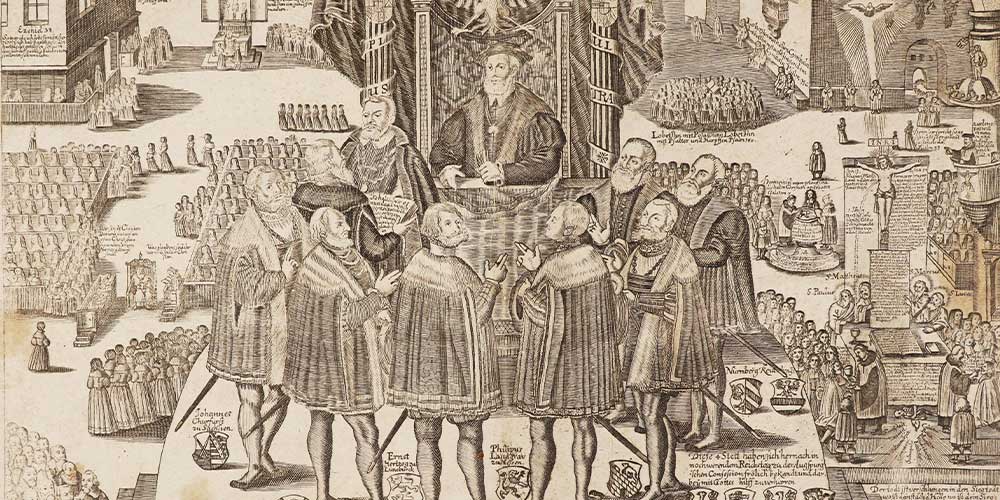
They were laymen. They were courageous political leaders. And they were faithful Lutherans. Theirs is a truly fascinating story—an account of incredible courage, life-or-death drama, and unwavering conviction.
It was the summer of 1530. Nine years earlier, Emperor Charles V had summoned Martin Luther to Worms. There the emperor ordered Luther to recant what he had been teaching. Luther refused. Instead, he confessed boldly that his teachings were based on nothing other than the Word of God. Luther was declared a criminal and a heretic and sentenced to death.
During the following years, the gospel took root in many areas of Germany. It was embraced not only by the common people but also by their rulers, regional leaders such as John, Elector of Saxony; George, Margrave of Brandenburg; Philip, Landgrave of Hesse; and others. Those political leaders protected Luther and prevented his arrest and execution.
Now these rulers had been summoned to appear in Augsburg. Emperor Charles, a Roman Catholic, needed their help. The Roman Empire was being threatened in the east by the Turks and in the west by France. Through a combination of kindness and threat, Charles would try to stop the Lutheran movement, end religious controversy, and unite Germany against the threats to the empire.
Once again, Charles did not get what he was hoping for.
Since Charles had invited participants to share their thoughts, Elector John of Saxony asked Luther and his colleagues to prepare a statement that summarized their Lutheran faith. That statement, written by Philip Melanchthon, was signed by the Lutheran political leaders and read publicly before the emperor. The Augsburg Confession gently but firmly pointed out the errors of the Roman Catholic Church and defended the Lutheran doctrine from those who had distorted and mischaracterized it. It attempted to show that the Lutheran teachings were not departures from the teachings that had been taught in the Christian church since the time of the apostles but were teachings based on Scripture alone.
The Augsburg Confession remains one of the foundational statements of belief for Lutherans today. Every WELS pastor, teacher, and staff minister publicly states full agreement with the Augsburg Confession (along with the other five confessions of the Lutheran church) and vows to teach in full agreement with it. Lutheran confirmands promise to hold to the confession’s teachings because it is a correct summary of biblical teaching. We have adopted the Augsburg Confession as our confession because it presents biblical truth that does not change with the times or lose its relevance.
We have this precious summary of our faith because God moved faithful laymen—at the risk of imprisonment or even death—to stand before their emperor and confess what they believed. If you haven’t read the Augsburg Confession lately, I suggest that you do so. Being familiar with the Augsburg Confession will help you see more clearly the biblical basis for what you believe. It will help you understand what makes your Lutheran faith different from other Christian denominations. And, even though you may not be summoned to testify before an emperor, it will help you confess your faith boldly and speak your beliefs clearly whenever you are called to do so.
Read a newer translation of the Augsburg Confession, The Unaltered Augsburg Confession. Available at nph.net(opens in new tab).

Mark G. Schroeder | WELS President
Author: Mark Schroeder
Volume 113, Number 09
Issue: September 2026
Photo: Public Domain; Artwork by Johann Dürr