 |

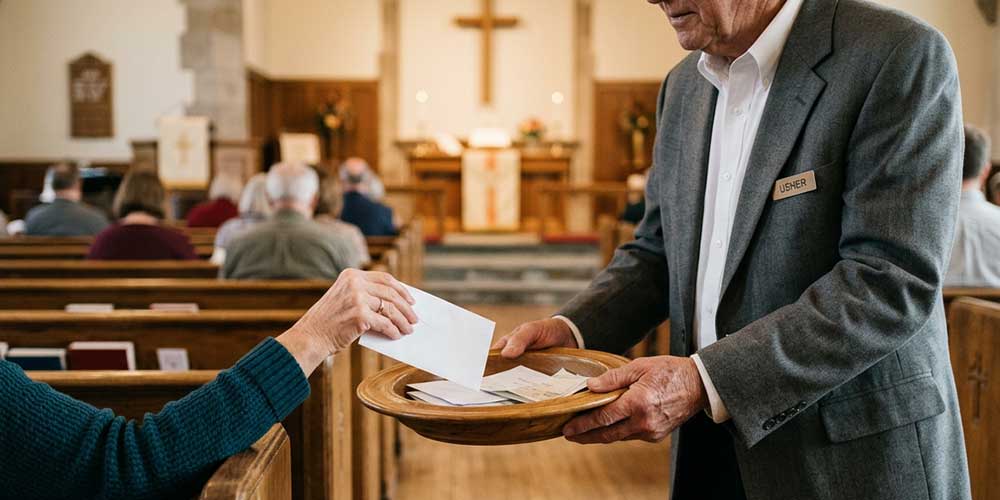
Can you imagine a pastor encouraging people to write on their church offering envelopes? I can.
Years ago at the congregation I was serving, I encouraged people to write on their Thanksgiving Day offering envelopes what they were especially grateful for on that holiday. I offered to publish their responses—anonymously—in the following month’s church newsletter.
The responses were minimal that first year, but they increased year by year. Eventually, pages of the December newsletter revealed heartwarming, specific reasons for thanksgiving. I recall things like “So thankful my grandson came home safely from deployment” and “Grateful that my husband was able to keep his job when the company downsized.”
I am not pretending that this practice is an innovative one. The writer of Psalm 116 wondered how he could give thanks to the Lord in a tangible way for one of his blessings.
That person faced a life-threatening situation. He called on the Lord for help and received it. Then the writer asked an appropriate question: “What shall I return to the LORD for all his goodness to me?” (Psalm 116:12).
We do not have to guess how the psalmist answered that question. He wrote, “I will lift up the cup of salvation and call on the name of the LORD. I will fulfill my vows to the LORD in the presence of all his people. I will sacrifice a thank offering to you and call on the name of the LORD. I will fulfill my vows to the LORD in the presence of all his people, in the courts of the house of the LORD” (vv. 13-14,17-19).
For the psalm writer, thanksgiving far exceeded words. In response to a specific blessing from the Lord, he resolved to channel his gratitude to the Lord through public worship and faithful, godly living—even giving a thank offering to the one who delivered him from his troubles.
The thank offering you and I give is quite different from the psalmist’s. He brought food to a priest; we tuck money or a check into an envelope and place it in an offering plate (or send money electronically). But the reason for those actions is the same: gratitude for the Lord’s love and mercy.
With this column, I am not suggesting that you write on your Thanksgiving Day offering envelope (unless you really want to). What I would encourage you to do is to think of a specific reason for your Thanksgiving Day offering.
Without question, our most important, specific reason for thanking God is Jesus Christ, his Son. In Jesus, we have forgiveness of sins, life, and salvation. Through faith in Jesus, those blessings are ours now and forever.
But so many other blessings come from the hand of the Lord. Perhaps you will have one of those blessings in mind as you give your Thanksgiving Day offering this year.
Certainly, “God loves a cheerful giver” (2 Corinthians 9:7). It is also true that God loves a thankful giver. For Christians, Thanksgiving means giving with thanks.
James Pope | FIC Editor
Author: James Pope
Volume 113, Number 11
Issue: November 2026
Photo: Firefly