 |
A church keyboardist reflects on 61 years of glorifying God through her music.
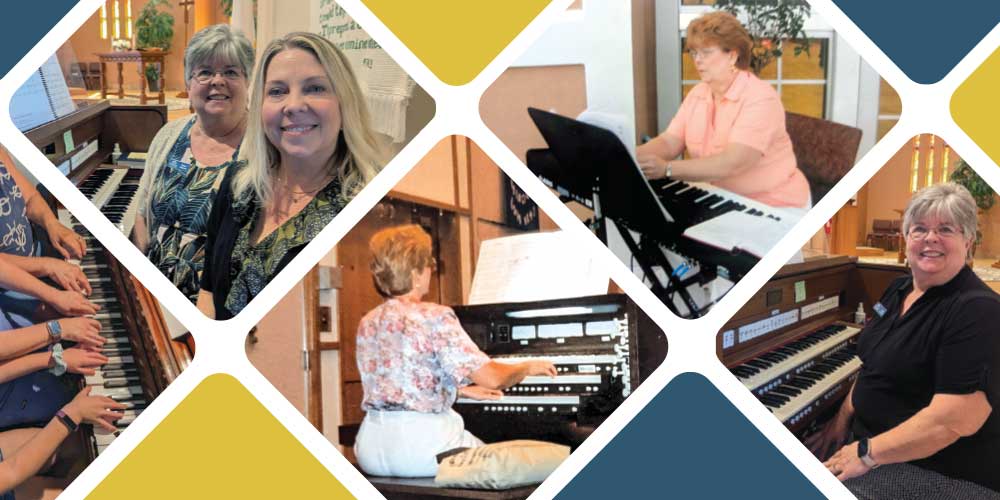
From pre-service to postlude, WELS congregations are grateful for the many faithful, talented musicians who have served and continue to serve for Sunday and weeknight worship, weddings, funerals, and other special services.
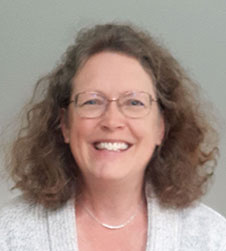
Esther Brassow Huebner, who recently retired from service playing after more than 61 years, is one of these musicians. But she’s not looking for accolades. “I’m more of a behind-the-scenes type of person,” wrote Esther in an introductory e-mail, “but thank you for this opportunity to share the privilege and blessing we have to serve the Lord and his people.”
An early start
The daughter of Michigan farmers-factory workers and the youngest of four from a family of church organists, Esther began piano lessons at the age of 5, “gently guided” by her dad. She practiced her lessons on the only keyboard her family had—an organ.
When she was 8, she started organ lessons with her pastor’s wife. When the pastor accepted a call and he and his wife moved away, 12-year-old Esther became the church organist. Esther remembers Sunday afternoons reading the paper and listening to her father’s favorite Bach and Handel albums—some featuring organist E. Power Biggs. Her dad’s encouragement still echoes: “Play like it’s someone’s last service.”
Esther attended Michigan Lutheran Seminary (MLS), Saginaw, Mich., for high school where her piano lessons resumed. About once a month she played for church at her home congregation in Dexter and a mission congregation in Ann Arbor. She also accompanied the MLS choir. “I loved playing the keyboard. I was drawn to it, so I didn’t have much trouble practicing,” she says. “When I was a student at MLS, you could always find me in the practice rooms.”
Upon graduation, Esther enrolled at Dr. Martin Luther College, New Ulm, Minn., and again took up organ instruction. In June 1970, Esther was blessed to play for the installation of her home church’s new pastor, John Huebner, fresh from Wisconsin Lutheran Seminary. Six months of weekly letters and Sunday night phone calls later, the couple celebrated a Christmas Eve engagement and were married June 26, 1971.
A life of service
In the following years, Esther devoted herself to serving as a pastor’s wife, raising their three children, giving piano lessons, working outside the home, and playing organ. John writes that he “greatly appreciated the fact that he always had an organist to play for services!”
Balancing all of this wasn’t easy. “For a long while, I was the only one playing for services, and I worked full-time outside the home,” says Esther. “We had wonderful members who would sit with our three children on Sundays, and I did most of my practice on the weekends. Many times, I would arrive early Sunday morning.”
Together with her husband, Esther served at Faith, Dexter, Mich.; Ascension, Sarasota, Fla; Christ, Columbia, Ma.; and Shepherd of the Lakes, Land O’Lakes, Fla. In August 2013, the Huebners retired to Jacksonville, Fla., where Esther continued to play at Victory Lutheran Church. She’s also been privileged to play for two national Lutheran Women’s Missionary Society conventions, music festivals, and many weddings and funerals—roughly three thousand worship services!
Grateful that the Lord provided many talented organists—including her daughter—at her current church, Esther quietly retired in June 2025. She was not the organist on that day; she just had cake! “I miss the bench—the conversation between you and God—but I do like sitting in the pew, worshiping corporately with everyone around you,” she says. And she still has all her music and is available for funerals and substituting as needed.
Music memories
Besides the special joy of giving her own daughter piano lessons and seeing her become a church musician, Esther has many memories of service playing. At first, she “favored Reformation” with its “strong and powerful music,” then Easter, but Christmas piano and organ music are her current favorites. “I also like to play for funerals with the beautiful music reminding us of eternal life with Jesus,” she says. A favorite hymn is “It Is Well with My Soul.”
Esther has played everything from a funeral home chapel organ to “a new, beautiful big organ” to a portable keyboard. When she first saw that small instrument, Esther remembers thinking, Lord, if this is what you want me to do, then we will make this instrument sound as best we can for your sake! She then played it for 13 years!
But when she got the chance to go back to playing organ . . . she jumped at it. “When we retired to Jacksonville, I was asked to join my daughter in playing,” she says. “I worked hard to bring my organ skills back up to where I was comfortable on the bench.”
Esther has had her share of unexpected playing moments, including a bride being 45 minutes late for her own wedding and a freshly waxed organ bench that sent her and her music sliding. One Easter Sunday, the organ quit mid-hymn when a fuse blew due to the men making Easter breakfast pancakes in the kitchen. A visiting seminary student was accompanying Esther on his trumpet. “When the organ stopped, he played the next verse solo, then the men fixed the fuse, and the organ was ready for the next verse,” she says. “Everyone thought it was planned!”
She was not on for playing one Sunday, and she wondered why there was no pre-service music. Soon the pastor tapped her on the shoulder, asking her to play for the absent organist. The mission church was meeting in a rented facility; the sole music was the red hymnal with its melody-line only liturgy. She managed, but after that day, “I brought along my music bag each Sunday and purchased my own liturgy book, just in case!” she says.
A rewarding ministry
Esther says she tries to encourage young people considering church music. “This is a very rewarding area of ministry . . . a way to give back your talents that the Lord gave you.” She reminds them that Martin Luther wrote, “Next to the Word of God, music deserves the highest praise . . . that he should proclaim the Word of God in music.”
Under the category of things the average congregation member may not realize, Esther says, “An organist can never have too many books! We purchase our own books, which are not cheap. We love what we are doing and will put in the time to practice, making sure the worship is beautiful and pleasing to our Lord.” Esther averages more than ten hours of practice the week before playing for a service—even after 61 years. “I always pray before I start the first note of pre-service music, ‘Let my music glorify God, not me,’ ” she says.
Esther urges congregation members to express appreciation to their organist/pianist. “If you enjoyed a particular song, don’t be shy—let your accompanist know it! They will be delighted that someone noticed.”
She continues, “The Lord has graciously given me a special talent. I have loved playing for church since I was young. It has been my way to give back to the Lord for this wonderful and beautiful way I can serve him! I hold this privilege very dear to me. I find it purely enjoyable and never a burden to play in a way that pleases and leads the worshipers . . . but especially to please my Lord. I will never forget his gift of playing to me and for my eternal salvation through him. I am truly blessed to have played 61 years to his glory!”
Thank you, Esther!
Author: Ann Ponath
Volume 113, Number 1
Issue: January 2026
Tales from the organ bench
Along with the blessings of serving God and his people as a church organist/pianist often come surprising—and sometimes funny—memories. Here are just a few:
Lois Hartman, an organist of 55 years primarily at Good Shepherd (now Beautiful Savior), Benton Harbor, Mich., remembers one Reformation on which she planned to play the last stanza of “A Mighty Fortress” extra well and “mightily.” Registrations were set and her “mood was one of joy.”
Lois was wearing a new pair of slacks, and during the hymn’s introduction, she realized that her pants were causing her to slip off the bench. “With each verse I was slipping more and more, and I was wondering how this would end. Forgetting how I had planned to play that fourth verse, I knew I just needed to be able to finish without sliding completely off. Somehow I got through it, but then came the liturgy!”
Lois looked around during the Bible readings for a solution. “This was during COVID, so my eyes landed on the spray bottle of hand sanitizer,” she says. She reasoned that if she sprayed the bench, it would provide traction—and it worked! “Whenever there was a pause in the singing/ playing, I would spray. With my dear Lord besides me helping, I made it through the service. However, when I got off the bench, I realized the spray had taken the varnish off! The mark remains on the bench to this day.”
On a hot summer day, 13-year-old Esther Brassow Huebner was playing for her cousin’s wedding, her first as organist. During the piece directly before the processional, an oscillating fan picked up a page of her music, sending it toward the balcony ledge. Esther’s father reached over to catch the wayward music, but it continued its flight over the ledge, immediately followed by a large crash as Esther’s father fell on the organ keyboard!
Ann Ponath, organist since 1991 at Christ, North St. Paul, Minn., remembers playing “Canon in D” over and over for a wedding processional as she scanned the aisle from the balcony, wondering, Where is the bride? Later she discovered the reason for the delay: The flower girl tasked with strewing flower petals in front of the bride not only threw the petals down the aisle but also went back and picked them all up again—just as she’d been told to do at the wedding rehearsal the night before!
Share your favorite memories as a church musician.