
 |
The 2025 Statistical Summary & Analysis does not tell a simple story. There is good news. There is hard news. And there are several findings that may surprise you because they do not fit your first assumptions.
This year’s report is different from a typical annual summary. Because 2025 is a benchmark year, divisible by 5, the report looks more deeply at long-term patterns. It examines trends over 5, 10, 25, and even 50 years. That broader view helps us see not only what happened but also what has been slowly developing over time.
That is why statistics can be useful. They do not define the church. Christ does. But statistics can help us see where the Lord is blessing us, where our assumptions need correction, and where our work needs renewed attention.
Membership
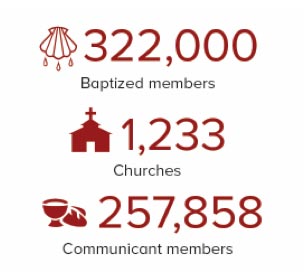
One example is outreach. WELS ended 2025 with 322,000 members, down 5,943 from 2024, the largest single-year loss ever. At the same time, WELS recorded 4,241 adult confirmations, the highest total in its history. The Lord is pulling new adults into WELS at a higher rate than a generation ago.
That is a remarkable blessing. So why is total membership still declining? Because gains are only half the story. WELS is also experiencing significant losses. Some are life cycle losses, as deaths now exceed births. Others are spiritual losses, as members drift away or leave for churches outside our fellowship. Outreach and assimilation must be held together. It is not enough to bring people through the front door. We also need to help them become rooted in worship, relationships, service, and Christian community.
Those losses also are not spread evenly across every age group. A significant part of the decline is concentrated among younger demographics: children, teens, and young adults. That has long-term implications. Fewer young adults today mean fewer young families tomorrow. Fewer young families mean fewer children in congregations and schools, as well as fewer people to train for ministry. In other words, losses among the young do not remain isolated. They ripple through almost every other part of WELS life.
Another surprising finding comes from our Lutheran schools. School enrollment is near historic highs. About half of our enrollment is children from outside our fellowship. That is a large mission field. Yet enrollment growth has not produced equivalent membership growth. Schools provide sustained contact with families, but contact is not the same as growth. Congregations and schools need intentional pathways that connect families to Bible instruction, pastoral care, and congregational life.
Called workers
The called worker data also challenges a common assumption. WELS has vacancies, to be sure. But the main issue is not that WELS has fewer called workers than in the past. In fact, WELS has more called workers than ever.
The pressure comes from the relationship between workers, members, and ministry opportunities. WELS has nearly 100,000 fewer members than it did in 1990, but it continues to support and even expand a broad ministry footprint: congregations, schools, missions, ministerial education, and specialized ministries. Vacancies are not only a recruitment issue, but they are also a deployment issue. We need to think about the whole challenge, not just the half that is worker supply.
Finances
The financial data is also interesting. Local giving has been remarkably strong. Congregational offerings have generally kept pace with or even exceeded the rate of inflation, a powerful testimony to the generosity of God’s people. But Congregation Mission Offerings are substantially behind inflation, meaning less financial capacity for our shared synodical work.
Births
Even the birth data is more nuanced than it first appears. WELS now reports more deaths than births.
But the primary issue does not seem to be that young WELS families have stopped having children. Rather, WELS has fewer young adults in the years when most marriages and births occur. That points us back to young adult retention and the long-term effects of losses among youth and young adults.
These are only a few examples. The full report also examines worship attendance, Bible study participation, congregational size, district data, and more.
Because every number represents a soul loved by Christ, the numbers are worth reading carefully. I encourage WELS members to read the full summary with clear eyes, grateful hearts, and confidence in the Lord of the church.
View the full statistical summary.
Volume 113, Number 08
Issue: August 2026