
 |
Why women are leaving the church and how we invite them to stay.
A discussion about women and the church can feel scary. It can be challenging and time-consuming to engage in healthy, godly conversation about the best way to apply God’s unchanging design for men and women in a complex, ever-changing world.
Unfortunately, like politics at Thanksgiving dinner, this topic has been avoided for far too long in many circles. And during that time, there has been a slow and quiet exodus of women from the church. They haven’t lost their faith or expressed theological differences with the church. They just don’t know where they belong.
What’s going on
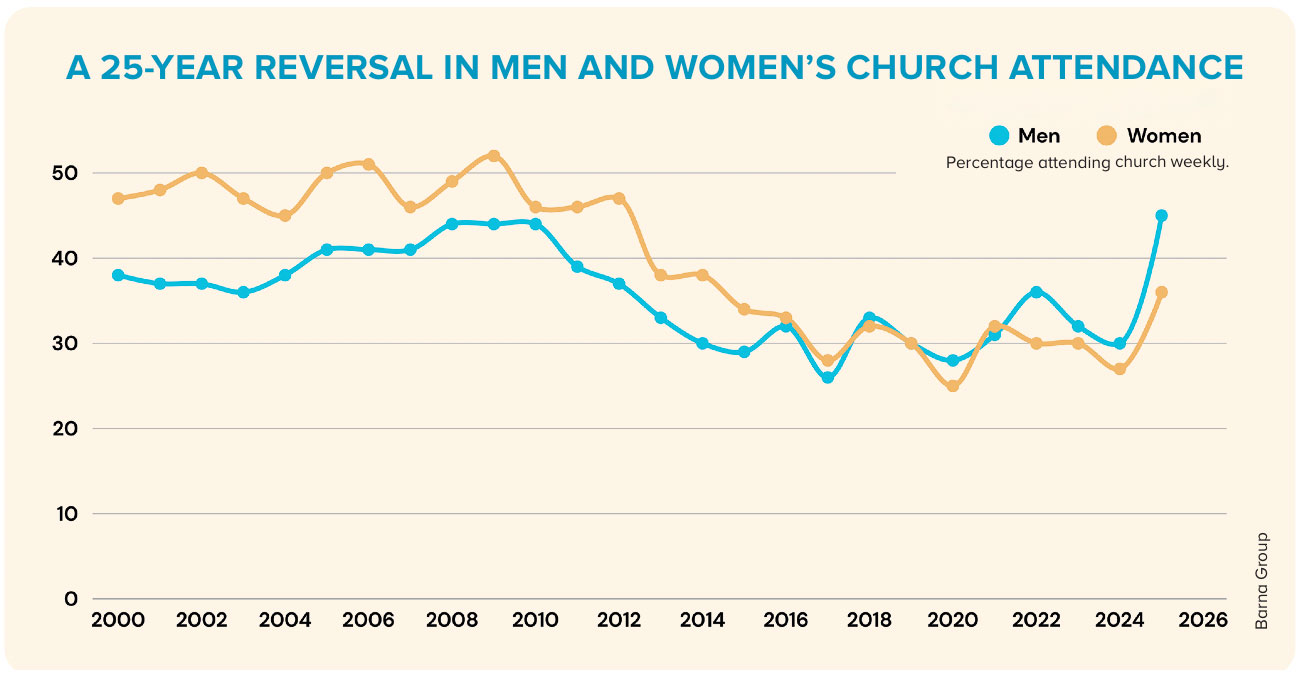
Over the last 25 years, women have left the church at alarming rates. In 2000, about 47 percent of women attended church on a weekly basis. Twenty years later, that number plummeted to 25 percent, meaning only one out of every four women attended church regularly.¹
Recently, attendance rates have slightly improved for both genders. However, the 25-year decline was so steep that now women attend church less than men do. Even secular data analysis is highlighting the significance of this reversal, since historically women have always been considered more religious as demonstrated by their faith practices.
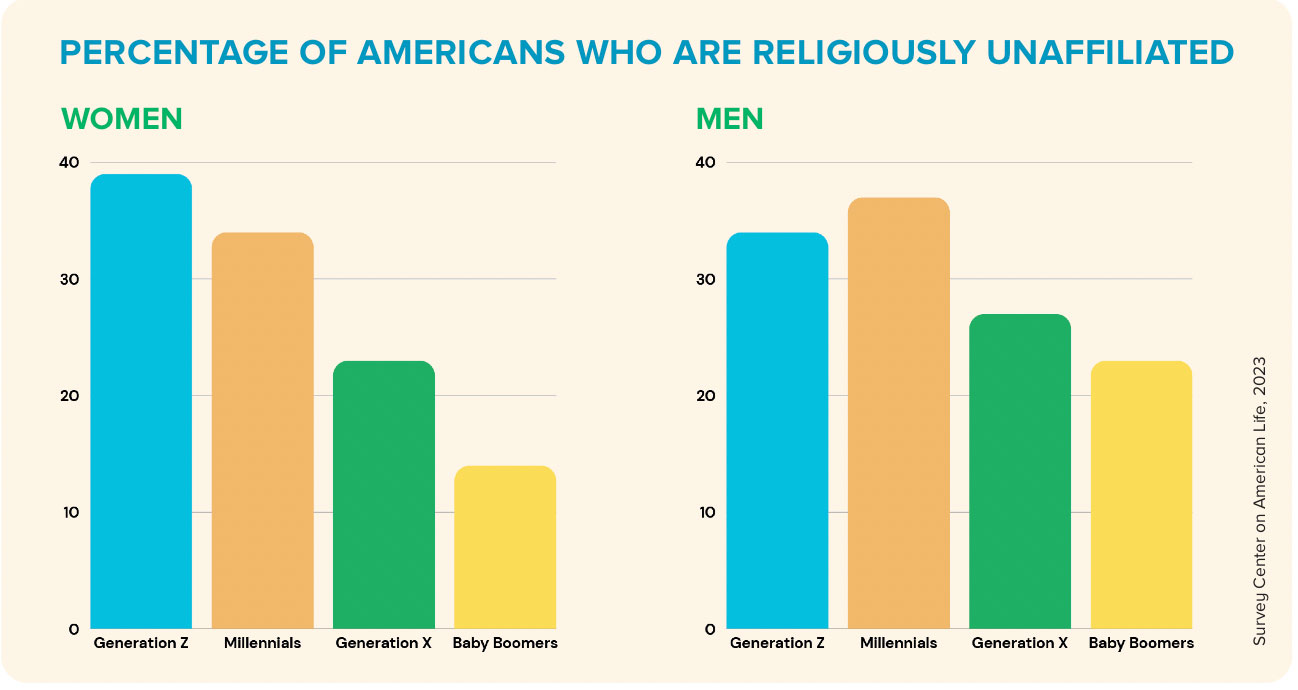
This trend is accelerated among younger women. About 40 percent of Gen Z women (those currently between the ages of 14 and 29) say they have nothing to do with church or faith practice. That is 5 points above men of the same age and 25 points above women from the Baby Boomer generation.²
No matter how you look at it, the numbers are showing that women are leaving the church at historic rates. The younger they are, the faster they are going. And this is not just going on in other church bodies; it’s happening in WELS too.
What’s not the problem
Before looking at why women are leaving the church and what can be done about it, we must pause to stand in awe of God’s design for men and women in order to affirm that his principle is not the problem. His design for men and women and the flawless principle that guides it are not broken. We are.
Only through the selfless sacrifice of Jesus that redeemed us as brothers and sisters in Christ can we rightly see how to apply his Word to our current context, hear the struggle of women who are leaving, and be motivated to change in scripturally appropriate ways to bring them back.
Why women are leaving
While many women (and men) leave the church because they no longer see the value of belonging to one, several other reasons for the “dechurching” of our society today are unique to women. Multiple articles that I’ve read from different denominational church leaders highlight these reasons, and surveys and interviews that I’ve conducted with women who are members of WELS verify these facts. You will see some of these women’s thoughts in the quotes that follow.
Burnout. Over the last 150 years, doors have opened for women to move into the public sector and pursue professional opportunities in a way never seen before in history. However, women also still carry a large part of the responsibility for maintaining life in the home. This burden has become crushing, and most women are just trying to survive.
Here’s how it looks for one woman on a Sunday morning: “On weekends, women just want to shut down. It’s a nightmare to imagine having to wrangle little ones in church. Can you imagine then how hard it is being told you’re not raising your kids the right way because you want to send them to a childcare program during the service just so you can have enough bandwidth to get spiritually fed?”
Social disconnect. Some women are not interested in or are delaying marriage and family. This can make it difficult to connect because they don’t share the same experiences or interests as wives or mothers. Dating questions become awkward. Without husbands these women feel they don’t have a voice in congregational life. Women can also feel isolated when much of the church’s ministry is geared toward the nuclear family. Although family ministry is important and Scripture certainly supports the nuclear family, this can lead to single women or married women without children finding it difficult to know where to plug in or connect.
Here’s what one woman told me: “Married individuals are hesitant to engage with me even when I try to engage with them. So much of the ministry of the church focuses on children and the nuclear family and that is not my life situation.”
Another woman said, “At times, as a single woman actively involved in church, I feel that people don’t listen to me. It feels like I need to have a husband in order for people to even attempt to listen. It’s like my relationship status has more weight than my identity as a child of God.”
The loneliness epidemic. Loneliness is a reality in our world today. Unfortunately, women aren’t finding connection and belonging in the church. Here’s what that sounds like:
“Women’s Bible study is specifically for moms.”
“The congregation is so large that I couldn’t say whether half of the people are visitors or not.”
“Most people only hang out with their clique.”
“Sometimes I feel awkward and by myself, and when no one reaches out or checks in, it leaves me feeling unseen and unimportant.”
Growing gap in opportunities. Women are finding a growing gap between how they contribute outside the church compared to inside the church. One woman said, “I run a $100 million division in my company. I don’t feel like my time is best used bringing bakery items to church. I am very capable of making large decisions.”
This woman doesn’t want to run the church or be the pastor. She would just appreciate the opportunity to contribute when a need arises that aligns with her skill set or spiritual gifts.
Another woman described her experience like this: “I go to work where I can be involved with leadership and church where I cannot. I feel like my two worlds are disconnected.”
When the church hasn’t kept pace with the growing number of ways and areas for women to contribute meaningfully in scripturally appropriate ways, women don’t know where they belong.
Political polarization. In a survey of WELS women, one in five listed political polarization in the top three cultural pressures negatively affecting their faith or connection to the church.
When asked what kind of church women longed to see, one woman said a church that is “accepting of all people, no matter the political background or their past. Preaching God’s Word with both honesty and kindness with no division of its members.”
Women are looking for conversation and actions that differ from the political landscape, not a church that mirrors it.
Speaking faith. Whether in the classroom, at the office, on an errand with kids, commuting to work, or at the park with friends, women are constantly bombarded with questions on hard issues such as gender identity, abortion, euthanasia, and morality. When women don’t have the words, confidence, or experience to give an answer or share their hope in Jesus, they either feel like a failure or fall prey to the world’s message because they don’t have the words to defend against it.
Autonomy. This is the first time in history that women have the choice, the autonomy, and the acceptance from a large majority of those around them saying that it’s okay to leave the church. And so they are. “For most young women who leave it’s not about any one issue. Most Americans who leave their formative faith say there was no single reason or catalyzing event that pushed them out. Rather it was a steady accumulation of negative experiences and dissonant teachings that made it difficult or impossible to stay.”³
Women are leaving WELS too
In surveys done by WELS Congregational Services, a common reason women give for leaving the church is a lack of opportunity to serve in a way that fits their skills and interests. They don’t feel heard or they don’t feel that their gifts are being utilized. Sixty-four percent of WELS women ages 18-34 “highly disagree” with this statement: “I am using my God-given gifts and talents to support the mission of my congregation.” Eighty-four percent of single, young women say they can’t or don’t know where to serve in their congregation.
In another survey of WELS women still attending a WELS church, 20 percent of women, aged 18-24, say they felt disconnected from their church. The number jumps to 33 percent among women aged 25-35 who say they felt disconnected or very disconnected from their congregation.
These women don’t want to leave; they just don’t know where they belong.
What we can do
Research, presentation, and discussion of this exodus with different audiences have allowed me to consider the varied perspectives, vantage points, and contributing factors of this issue. The conclusion that I’ve come to is that each one of us, in our own ways, is not only capable but also responsible to the Great Commission to see, hear, and value the gift of women God has given to the church. How that’s done will look different for congregational leaders, pastors, teachers, older or younger women, and men. But each of us can do something.
If women are leaving because they don’t know where they belong, then we must show them where they belong and help them understand that they will be missed if they leave. This can be done when we see, hear, and value God’s gift of women.
See = Relationships + Connection. Jesus took time to get to know the woman at the well. Do we do the same? Do we see the women in our congregations? Their interests? Their struggles? Do we see their daily lives to understand the choices they make with their time, talents, or treasures? Do congregational decisions regarding scheduling, childcare, and ministry programs reflect that understanding?
When asked “What creates a sense of belonging in your church?” a few Gen Z women said, “A quick hug from a member, a text out of the blue, or hanging out outside of church.” “A kind ear, gospel love, and Christian understanding.” “Relationships that go beyond Sunday worship.”
Relational and intentional connection demonstrated by thoughtful consideration go a long way in ensuring women feel seen and in creating a welcoming environment.
Hear = Insight + Perspective. It is by God’s design that men and women have differing insights, perspectives, and ideas. In this way we complement each other and build up the body of Christ. If the insights and perspectives of women are absent from congregational decision-making, we miss out on the blessing God intended for the church through his gift of women.
Women aren’t looking to be the pastor or lead the church, but they are eager to contribute when their experience or expertise aligns with a need in the church. Is there a way for them to do that? Are there clear pathways for women to share perspectives, insights, or ideas when congregations are making decisions, crafting ministry programming, or reaching out to the local community?
Suggested avenues are as varied as the congregations within our synod. In some congregations, the pastor has a trusted deaconess he meets with regularly. Other congregations host open forums and use surveys. In some congregations, elders intentionally meet with female congregants to ensure every voice is heard. Still others have structured themselves in such a way to allow ministry teams of men and women to contribute to the planning of the church.
Value = Mission + Purpose. The believing woman knows she is God’s handiwork created for works of service in his kingdom. But often she doesn’t know how or where or in what way she should serve. When those questions are left unanswered, a woman will either seek her value elsewhere or believe she has nothing to offer.
When we encourage a woman by helping her identify her gifts, equipping her to use them, and seeking meaningful opportunities to engage those gifts, the church affirms the value and purpose God has for her.
This starts right where she is. To the glory of God, a woman’s gifts are for the benefit of those in her home, neighborhood, workplace, and community. She is a living stone, the salt of the earth, a light on a hill, and carries the aroma of Christ. Can we communicate the value of her daily walk as a disciple right where she is? Can we nurture, encourage, and equip her to live as an ambassador of God’s grace, speaking truth in love while serving those around her as the hands and feet of Jesus? This builds up our partnership in the gospel and carries out the work of God’s Great Commission.
This is true for engaging the gifts of women in meaningful ways within the church as well. As you look at the life of your congregation, are the gifts God has given to women being actively engaged in ways that are faithful to Scripture? If not, could it be time for an honest assessment of current practices and a deliberate study of Scripture to discern better how to encourage and support the faithful use of women’s gifts without compromising the principle given in God’s design for men and women?
The quiet exodus of women from the church didn’t happen overnight. This is 20-plus years in the making. During that time, Adam’s joyful words at the gift of woman have been muted by our sinful nature, the world, and the devil. We’ve not cherished the precious gift of God’s design for men and women or taken the struggle we see as loss to the foot of the cross.
But, in his mercy, God has opened our eyes to the opportunity before us to communicate belonging and value to women, to bear with one another in unity for the sake of the gospel, and to honor God as we faithfully live out his calling for men and women in a way that follows his design for us. May God give us his heart to do just that.
Watch a presentation given by Dawn Schulz and Paul Wendland on this topic at the 2026 WELS National Conference on Lutheran Leadership.
¹barna.com/trends/church-attendance-women-men
²americansurveycenter.org/newsletter/young-women-are-leaving-church-in-unprecedented-numbers
³aei.org/articles/young-women-are-leaving-church-in-unprecedented-numbers
Author: Dawn Schulz
Volume 113, Number 08
Issue: August 2026
Image: Adobe Stock
No room for loneliness
We often talk about “fight or flight,” but there’s a third response: “freeze.” It’s one you may recognize in yourself or in others. Perhaps it’s even something you’ve seen contributing to a quiet drifting away—an unspoken exodus of women from your church.
If I am not as involved in my church as I would like to be, but I don’t know how to be engaged, what am I going to do? Ask? That’s absurd.
Instead, I called my mother on the way home from work, one of those tear-blurred FaceTime calls that rendered me a danger to both myself and everyone else on the road. I so desperately tried to express my confusing and disorienting feeling of loneliness in my church. A loneliness marked by an uncomfortable dissonance between my faithful attendance and unknown presence. A loneliness, not as a visitor or newcomer who begged to be welcomed, but as a lifetime churchgoer who knew her way around a church, just not this church. A loneliness that didn’t feel warranted because I was surrounded by brothers and sisters in Christ. A loneliness that felt debilitating to my faith.
I like to imagine God looking down at me with a loving but sly grin. His utter fool of a child was about to get the blatant answer she so desperately begged for.
The next day, this fool decided to surrender her Friday night to attend the Women & Worship event at St. Marcus in Milwaukee, Wis. This event was for all ages of women in the church simply to worship. In Word, in song, in prayer, for just two short hours, I rested in the surpassing greatness and inexhaustible compassion of God. I was so fully immersed in the most magnificent combination of his almighty power and quiet tenderness that no space was left for loneliness.
God’s loving and sly grin grew just a little wider.
The leader of the event closed the night with announcements, including needing volunteers with musical talent for the next event. My friend gave me a playful nudge and said my name in a singsong manner—a rather poor excuse for a whisper. Before we could leave our front-row seats, I glanced at the guitarist. He had his eyes locked on mine. He pointed right at me and said, “YOU! You’re musically talented, aren’t you?” I hesitated. “Too late. Your friend called you out.” So, I walked over, and we began a conversation about how I play the piano. He kindly but firmly insisted I talk to the leader, as the group is always in need of musicians.
Dear sisters in Christ, there’s no room for a quiet exodus when there’s a deafening “YOU!”
For those of you who are frozen, God is waiting for you with his sly but loving grin and open arms. Ask. Go. Be so filled that there’s no room for loneliness.