 |
A layperson serves gospel comfort to those who serve.
A misdialed phone transfer, a post-wedding move, and a desire to serve. These are all factors that led Mark Kleisner to the Duluth, Minn., sheriff’s department to serve as a chaplain for law enforcement personnel in northern Minnesota.
A new role
After graduating from Shoreland Lutheran High School, Somers, Wis., Kleisner, now 33, went to culinary school and worked for about 12 years as a corporate chef in the Chicago area. While he found ways to serve God and others in that role, he had a desire to do more.
In his early 30s, he was preparing for marriage and a move to Duluth, while seeking a way to leave corporate burnout behind and serve others with God’s love.
“I struggled back and forth a lot about what to do,” says Kleisner. “So I sat down with my pastor, and I asked him for advice. I wanted to do something different; I felt like God was calling me to do something, but I couldn’t figure it out.”
Not long after that conversation, Kleisner was asked to call Martin Luther College (MLC), New Ulm, Minn., on behalf of his congregation, Immanuel, Waukegan, Ill., to inquire about congregational training programs for evangelism. He was redirected to someone who was involved in chaplaincy work. It was a simple error. What started as a brief conversation about who he was actually trying to reach turned into a long conversation about chaplaincy work. He was intrigued. This was a way he could actively serve God and others as a lay member while maintaining his personal career interests.
“I may have taken it more seriously than I should have, but at the moment I considered that it was God telling me what I needed to do with my life,” he says. “So, I went the next day and talked to my pastor about it. We reached out to Pastor Joel Gaertner from WELS Special Ministries, and he walked me through the program. That afternoon, I applied.”
A few weeks later, he was accepted into MLC’s Chaplain Certificate Program and began courses shortly afterward. He finished the certification requirements right before getting married and moving to Duluth in September 2024.
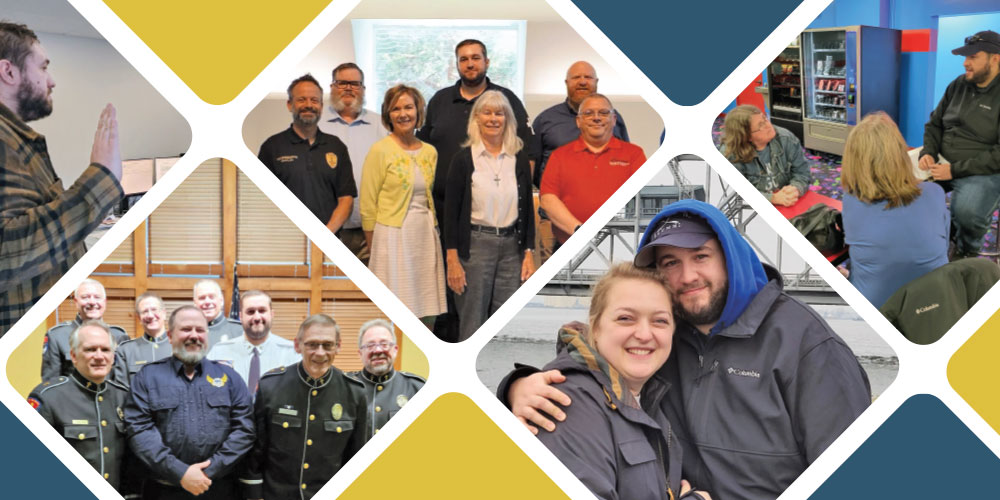
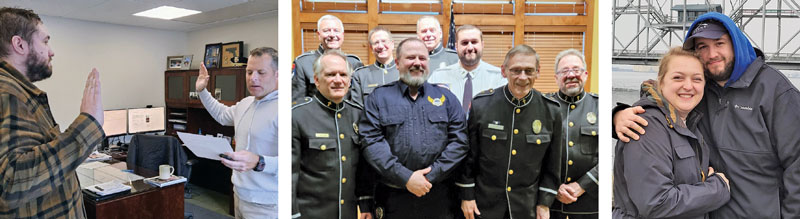
Once in Duluth, Kleisner learned about the area’s law enforcement chaplaincy program and was sworn in as chaplain by the St. Louis County Law Enforcement Chaplaincy, which serves all law enforcement in this large northern Minnesota county. He shares chaplaincy duties on a rotation with other chaplains for the area. Since it’s not a full-time job, he runs a wedding venue and catering service in the summer and works as a substitute teacher during the school year. It’s a schedule that allows him the flexibility to do ministry as a chaplain while also pursuing his career interests.
A new opportunity to serve
Kleisner’s role as a chaplain includes many different duties and situations: being on scene for an accident, providing support during a death notification, and just being available for the officers if they need to talk. Since an officer’s “office” is his or her squad car, that often looks like a ride-along for a day. He’s been in some tough and terrible situations but is thankful that in those moments, God gives him the strength to face what’s happening and support the officers and people of the community.
The overarching message Kleisner tries to share with the officers he serves—whether it’s following a death notification, domestic situation, or accident—is that the Lord will always be there to help them.
Kleisner explains, “A common problem in law enforcement is substance abuse and suicide rates. Most of the time when that happens, it’s because they’ve lost hope and they don’t know how to get past whatever they’re dealing with. As a chaplain, I can help remind law enforcement personnel that this isn’t the end.”
Ultimately, he’s there to provide comfort and hope. “When I was [in the chaplaincy program], I learned about law enforcement, fire department, hospitals, the military—all the different facets of chaplaincy work. The reason I stuck with law enforcement is that not everybody can do it. I’ve seen things and experienced things that I honestly thought would have broken me, but they haven’t,” says Kleisner. “I realized that sometimes God calls us to do something.”
He also learned that God gives his people the strength and ability to perform their work. “A lot of these officers are going through really horrible situations, and they don’t have support. I realized that for whatever reason, God’s allowing me to do this. I was drawn to these officers. I’d be the first to admit that no one knows what these officers are going through other than themselves. In working with them, I’ve learned more about what their job entails in the last year than I had in my entire life.” Even though he has to face death, crime, and some of the worst situations from sinful humanity, he says, “It doesn’t stop me from wanting to help people.”
When he gets a call to assist, his prayer is that “I can share just an ounce or a glimmer of Christ’s love and hope to these people.” He continues, “If I leave a call and was able to remind them of Christ’s love—that they’re not abandoned and God doesn’t hate them—that’s the greatest hope I can have in one of these situations.”
Sometimes, his work as a chaplain will take him in unexpected directions. One young officer who has relied on Kleisner as a listening ear and a Christian counselor asked him to perform his upcoming wedding. As an official chaplain, Kleisner is legally authorized by the state and was honored, even though it’s something he never thought he would do. He says this would not have been possible without taking the time to build relationships with the people he serves.
Additionally, he is using his general knowledge and training as a chaplain to serve his congregation, Shepherd of the Hills. The congregation has had a pastoral vacancy since right after he moved to Duluth. He helps the vacancy pastor with hospital and member visits and is also looking to start an elder care and jail ministry.
Kleisner says that even as a lifelong WELS member he had never heard of the WELS Chaplaincy Certificate Program until that one misdirected phone call. But in this role, he has found an answer to the desire he felt to serve others using the gifts God has given him.
“If you don’t want to be in ministry full time but you want to serve the Lord, you can do it in any facet of life,” says Kleisner. “You can share the gospel anywhere with anybody at any time. The Lord’s always going to give you opportunities.”
Learn more about the WELS Chaplain Certificate Program.
Author: Amanda Klemp
Volume 113, Number 02
Issue: February 2026