 |
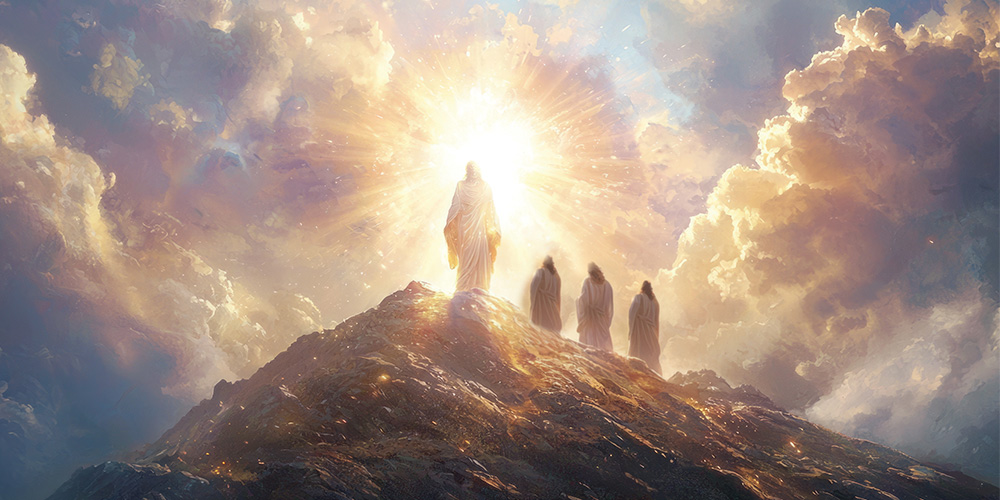
On that unforgettable night on the Mount of Transfiguration, we see Jesus as we’ve never seen him before: arrayed in overwhelming glory.
A good share of the reward for climbing a mountain is the view from the top. On a clear day from the summit of Maine’s Katahdin, you can see the White Mountains in New Hampshire. When you ascend California’s famed Half Dome, the payoff is a sweeping view of the Yosemite Valley. And from Mount Hermon, known as “the eyes of the Middle East,” you can see parts of Syria, Lebanon, and Israel—and with the right conditions, the Mediterranean Sea.
We can’t be certain that Mount Hermon (elevation 9,232 feet) was the high mountain on which our Lord Jesus was transfigured, but the context of the gospels of Matthew and Mark puts Jesus and his disciples at Caesarea Philippi just before the transfiguration. The region of Caesarea Philippi is located at the southern base of Mount Hermon.
Jesus didn’t take his disciples Peter, James, and John up the sacred mountain so they could enjoy a panoramic view of the landscape below. He took them up the mountain so they could witness his majesty as true God.
The transformation of Jesus
Most of the time, Jesus veiled his majesty. Though he was “in very nature God,” Jesus “made himself nothing.” “He humbled himself” (Philippians 2:6-8). The prophet Isaiah wrote about the Messiah in his state of humiliation: “He had no beauty or majesty to attract us to him, nothing in his appearance that we should desire him” (Isaiah 53:2). The appearance of Jesus was ordinary.
But on that extraordinary night on the mountain, the three disciples saw Jesus as they’d never seen him before. Peter later wrote about the experience: “We did not follow cleverly devised stories when we told you about the coming of our Lord Jesus Christ in power, but we were eyewitnesses of his majesty. He received honor and glory from God the Father when the voice came to him from the Majestic Glory, saying, ‘This is my Son, whom I love; with him I am well pleased.’ We ourselves heard this voice that came from heaven when we were with him on the sacred mountain” (2 Peter 1:16-18).
Jesus was transfigured, that is, his appearance underwent a profound transformation, a metamorphosis. As Jesus was praying, “the appearance of his face changed, and his clothes became as bright as a flash of lightning” (Luke 9:29). Matthew tells us that Jesus’ face “shone like the sun” (Matthew 17:2). Peter, James, and John woke from their sleep to see ordinary Jesus arrayed in overwhelming glory. Just a week earlier at Caesarea Philippi, Peter had confessed Jesus to be “the Messiah, the Son of the living God” (Matthew 16:16). Now Peter and his companions saw this confession confirmed.
The appearance of the prophets and God the Father
The disciples saw more amazing things. They saw Moses and Elijah talking with Jesus. These two towering figures from the Old Testament had gone to heaven centuries earlier. Moses was the prophet who led the Israelites out of Egypt, through the wilderness, all the way to the threshold of the Promised Land. The prophet Elijah was God’s point man to confront idolatry in the kingdom of Israel. Each prophet had engaged in conversation with the Lord at Mount Sinai at a time of great discouragement. Moses, after receiving the law from God, had gone up Mount Sinai again to intercede for the people of Israel after they worshiped the golden calf. Elijah left his post and fled to Mount Sinai in the mistaken conviction that he was the last believer left in Israel. At Sinai, God encouraged his faltering prophets.
Now Moses and Elijah were present at the transfiguration, speaking with Jesus about his “departure,” in Greek, his exodus (Luke 9:31). The exodus from Egypt was God’s great act of deliverance in Old Testament times by which he freed an entire nation from bitter slavery. After the transfiguration, Jesus would “resolutely set out for Jerusalem” (Luke 9:51) to accomplish a far greater act of deliverance: freeing us from the slavery of sin through his death as our substitute.
What the three disciples saw and heard next caused them to fall “facedown to the ground, terrified” (Matthew 17:6). A bright cloud covered them and the voice of God the Father said, “This is my Son, whom I love; with him I am well pleased. Listen to him!” (Matthew 17:5). This cloud was the glory of the Lord that had once shone on the shepherds in Bethlehem. There, too, the sight of it was terrifying. Its appearance over the fields of Bethlehem as well as on the Mount of Transfiguration signals not only that God is present but also that he is about to go into action in a supernatural way. God is moving to give his own Son, whom he loves, as the all-sufficient offering for human sin and guilt.
The importance of that unforgettable night
It was overwhelming and unforgettable to see the glory of the Lord and to hear the voice that came from the Majestic Glory. John would write later, “We have seen his glory, the glory of the one and only Son, who came from the Father, full of grace and truth” (John 1:14).
Peter was frightened by what he saw and heard, but he was rarely at a loss for words. He said, “Lord, it is good for us to be here. If you wish, I will put up three shelters—one for you, one for Moses and one for Elijah” (Matthew 17:4). Peter wanted to prolong the experience, perhaps indefinitely. He wanted to bring heaven down to earth and, possibly, make the mountaintop a place of pilgrimage.
It is good for us to see Jesus as Peter, James, and John saw him on that unforgettable night on the mountain.
But that was Peter’s fear talking. Suggesting that Jesus remain on the mountain was just a variation on Peter’s earlier proposal that Jesus didn’t have to suffer and die and then be raised to life. These suggestions were inspired by Satan. At the outset of Jesus’ public ministry, Satan tempted the Lord to take an easier path: turn stones into bread, leap from the highest point of the temple, or bow down to worship that destroyer of souls himself—any path but the one that led to the cross. We can be forever thankful that Jesus ignored Peter’s offer. Jesus, after he received glory and honor from God the Father, would not be deterred from enduring shame and humiliation in order to reconcile us to God.
Peter was right about one thing: “It is good for us to be here.” It is good for us to see Jesus as Peter, James, and John saw him on that unforgettable night on the mountain, shining in the heavenly glory that is his from eternity. It is good for us to hear the Father give glory and honor to his Son. These sights and sounds are intended to remove all doubt about the identity of Jesus. He is the glorious Son of God.
It’s vital that we remember this as we move into the season of Lent and see our Lord, when “his appearance was so disfigured beyond that of any human being and his form was marred beyond human likeness” (Isaiah 52:14). The true Son of God was willing to suffer all this to have us with him forever in heaven.
Author: Paul Janke
Volume 113, Number 02
Issue: February 2026