 |
A look at changes in US Lutheranism over the last 40 years.
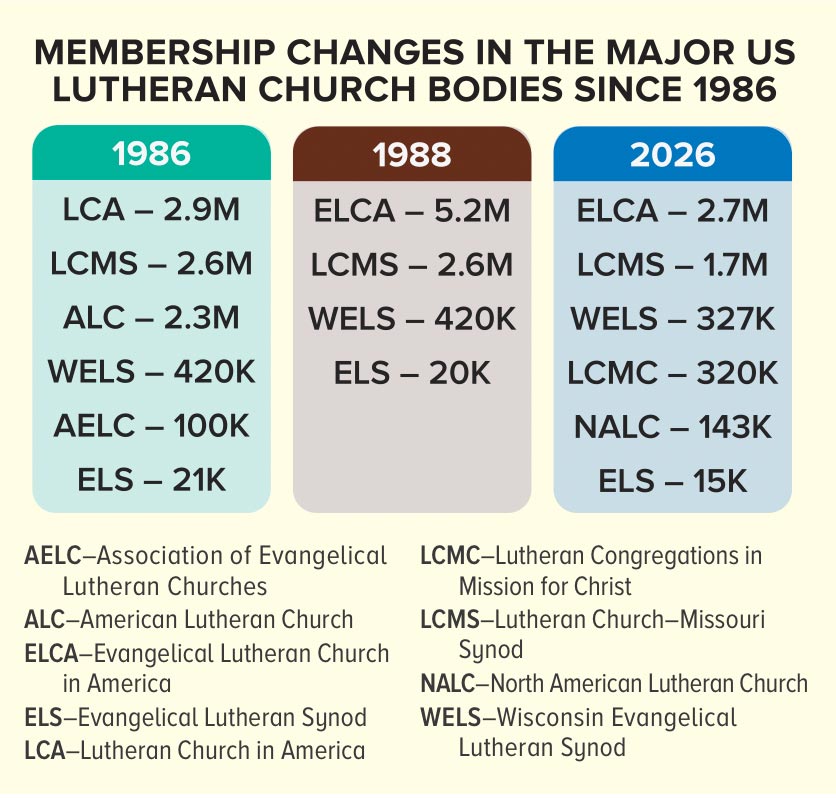
Forty years ago, in 1986, WELS was the fourth largest Lutheran church body in the United States, behind the Lutheran Church in America, the Lutheran Church–Missouri Synod, and the American Lutheran Church.
Just two years later, in 1988, WELS had become the third largest Lutheran church body in the United States, followed by the Evangelical Lutheran Synod, WELS’ sister synod, in fourth.
What happened? And how did that help shape Lutheranism in the United States today?
Evangelical Lutheran Church in America
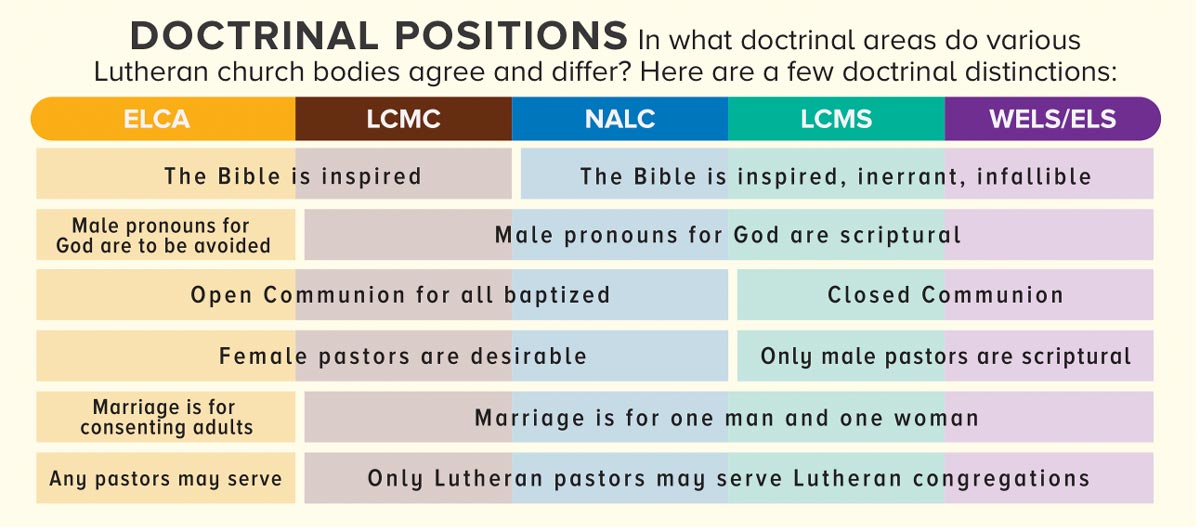
The difference started with a merger in 1988. The Lutheran Church in America (LCA) and the American Lutheran Church (ALC), which had ordained women into pastoral ministry since 1970, were joined by the Association of Evangelical Lutheran Churches (AELC). This group had been formed by congregations that did not believe that the Bible is inerrant and infallible and, therefore, left the Lutheran Church–Missouri Synod (LCMS) in 1976. Those three groups became the Evangelical Lutheran Church in America (ELCA) on Jan. 1, 1988.
Demographic decline in the ELCA began almost immediately. Deaths outnumbered births, and transfers out outnumbered transfers in. In the past 15 years, ELCA membership has declined 46 percent, from almost 5 million in 2010 to 2.7 million in 2025. If that trajectory continues, the ELCA will be smaller than the LCMS by 2034.
The ELCA began to declare fellowship with non-Lutheran denominations soon after its founding. In 1997, it established full communion with the United Church of Christ, the Presbyterian Church (USA), and the Reformed Church in America. That meant that the ELCA was sharing Communion with people who did not believe in the real presence and was sharing pastors who did not subscribe to the Lutheran Confessions. In 1999, the ELCA entered into similar agreements with the Episcopal Church and the Moravian Church.
In 2001, ELCA congregations unhappy with that ecumenical trend left the ELCA and formed the Lutheran Congregations in Mission for Christ (LCMC). The LCMC began with 25 congregations but now is up to 1,064. Most of those congregations did not join the LCMS, WELS, or the Evangelical Lutheran Synod (ELS) because they wanted to retain the option to have female pastors. But there is some movement in our direction. In February 2026, an LCMC congregation in Wausau, Wis., voted to join the ELS.
In 2009, the ELCA formally welcomed gay and lesbian individuals into what it calls “full participation.” The ELCA’s Churchwide Assembly voted that year to allow ordination of gay and lesbian clergy and to encourage same-sex marriages. In the years since, the ELCA has been promoting US political causes more openly.
In 2010, ELCA congregations unhappy with that sexuality decision left the ELCA and formed the North American Lutheran Church (NALC). This new synod began with 17 congregations but now is up to 532. Most of those congregations did not join the LCMS, WELS, or the ELS because they wanted to retain the option to have female pastors; however, some NALC congregations have inquired whether they could be served by WELS pastors. WELS pastors are responding by inviting members of those congregations to study Luther’s Small Catechism with them.
 Lutheran Church–Missouri Synod
The LCMS is seeing demographic decline too, faster than WELS but not as drastic as the ELCA. Its annual statistics record more deaths than births and more spiritual losses than gains. Its pastoral vacancy rate is higher than that of WELS, and the percentage of churches closing is greater as well. Some of the synod’s historic Concordia colleges have closed. But mission offerings at the LCMS headquarters are strong, and Matthew Harrison, LCMS president, reports a solid spirit of confessional Lutheranism throughout the synod.
One trend that marked the LCMS in the last 40 years was progress in dealing with pastors and congregations who remained in the Missouri Synod but supported those who left and eventually joined the ELCA. Because those dissenting pastors gradually retired and were replaced by more confessional Lutheran graduates from the LCMS seminaries, the synod as a whole has been returning to practices like closed Communion, a practice that WELS members recognize as consistently Lutheran and biblical.
Wisconsin Evangelical Lutheran Synod
In the 1960s and 1970s, WELS benefited numerically from individuals and whole congregations leaving the LCMS because they were distressed by those who left to form the AELC and by the LCMS congregations that sympathized with them. In the last 40 years, growth in WELS has come more often, humanly speaking, from an emphasis on clearly preaching the gospel and faithfully administering the sacraments.
We give thanks to God for numerical blessings in 2024*, when WELS had the lowest number of net spiritual losses (people who leave their WELS congregation without transferring to another WELS congregation) since that number has been tracked. In 2024, the Lord of the Church blessed WELS with just over 4,100 adult confirmations, the second highest total since that number has been kept. When you put those two things together, WELS’ total membership declined by only 2,675 members, to 327,943 (-0.8 percent). That is the smallest one-year decline in over a decade. Mission offerings remain strong. One possible reason: In 2024, reported in-person worship attendance, Bible study attendance, and youth study attendance (e.g., Sunday school) all rose—about 3 percent, 2 percent, and 1 percent, respectively. That was the fourth straight year those means-of-grace connections have risen.
This is not to say we do not see large challenges within the 2024 data. For the first time since WELS has been recording statistics, there were fewer than one thousand weddings in WELS. In 2024, there were again under three thousand births to WELS members. The 3,445 youth confirmations were the lowest total since the 1930s, when tracking began including a distinction between youth and adult confirmations. This is a result of the long decline in gross birth rate now matriculating up into the middle-school-aged demographic.
Evangelical Lutheran Synod
While demographic trends in the ELS mirror those in the LCMS and WELS, the smaller synod is more strongly affected when one or two large congregations join or leave the synod for doctrinal reasons. One of the strengths of the ELS is its operation of Bethany Lutheran College in Mankato, Minn.
The next 40 years
With the growth of membership in the LCMC from congregations continuing to leave the ELCA, soon WELS could again be the fourth largest Lutheran church body in the United States.
It is also possible in view of current statistical trends that in the next decade Christ would have WELS increase in overall numbers. However, statistical recovery is not the goal, but Christ’s prerogative. The goal is simply to give God glory through faithful mission efforts and zealous ministry to the one who has reconciled and commissioned us.
Learn more about WELS’ relationship with other Lutheran church bodies in WELS & Other Lutherans by John Brug.
Author: Paul Prange
Volume 113, Number 04
Issue: April 2026
Continued discussions

Leaders from the Lutheran Church—Missouri Synod (LCMS), the Evangelical Lutheran Synod (ELS), and the Wisconsin Evangelical Lutheran Synod (WELS) have been meeting annually for more than a decade for theological and church-focused conversations (not formal doctrinal discussions). Prior to that, only a handful of official meetings took place between LCMS leaders and ELS/WELS leaders from 1963–2012.
Leaders from these synods gathered again in December 2025 (pictured). The discussions centered on the synods’ understanding of joint prayer and prayer fellowship and how those have been viewed historically by the three synods.
Learn more about these continued conversations.