 |
Christian faith shines brightly in a family handling challenges.
After praying on her knees beside her bed, Judy Fraser stood up with a premonition: She was going to raise a special-needs child. Pregnant with her first child, Mark, a feeling swept over her that the Lord had special plans for her and her husband, Pat. Years later, she recognized those plans.
Early years
When Mark was born in 1983, that premonition was on Judy’s mind. She asked the medical staff in the delivery room, “What’s wrong with him?” The answer was “Nothing’s wrong with him. He’s perfect!” Mark’s Apgar scores seemed to confirm that: 9/10 on his first and 10/10 on his second.
In the days after Mark’s birth, the only puzzle for Pat and Judy was the color of Mark’s face when he cried. One side was red; the other was white. They learned later that the condition is called harlequinism. Pat recalls, “It’s our first child. What do we know? The doctor was not worried. Why are we going to worry?”
As Mark grew, he experienced frequent headaches. When he was six, Pat and Judy took him to a doctor, thinking that a tumor could be responsible for the pain. The visit yielded no new information about Mark’s headaches.
Judy considered him to be “an upbeat kid.” “We thought he was going to be a pastor,” she says. But then, five weeks after moving from Atlanta, Ga., to Melbourne, Fla., the Frasers’ world was turned upside down.
Crisis situation
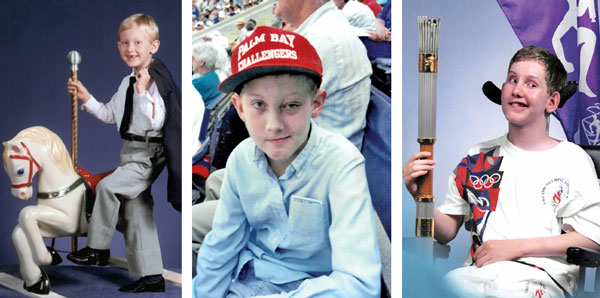
The morning after going to a circus with his family, Mark, 7, woke up with a headache. Judy told him he could stay home from school, but he had to stay in his bed. She readied Mark’s younger brothers, Daniel, 5, and Ben, 2, for the day and then checked on Mark. He started screaming.
Judy drove Mark to their doctor, who immediately called for an ambulance. A CT scan at a local hospital revealed that Mark had suffered a stroke.
The hospital personnel decided to airlift Mark to Arnold Palmer Children’s Hospital in Orlando, Fla. As the helicopter could not accommodate Judy and Pat, the parents would have to drive. Pat says they did so with the doctor’s warning: “Mark may not be alive when you get there.”
A neurosurgeon at the Orlando hospital sought information from Pat and Judy about Mark’s medical history. When he learned about Mark’s harlequinism, he informed them that it was a symptom of arteriovenous malformation (AVM). An angiogram the next day confirmed the doctor’s suspicion.
An AVM means that blood vessels are tangled together, restricting blood flow. An AVM in the brain the size of a peach is considered large; Mark’s AVM involved the entire left side of his brain. The neurosurgeon warned Pat and Judy that “Mark is a walking time bomb” because his AVM could bleed at any time or he could fall and injure his head, which could cause bleeding and death.
Now armed with a diagnosis, the parents had options: do nothing and hope and pray for the best; try to embolize the AVM (which turned out later not to be an option); or have the AVM removed, which meant removing the left hemisphere of Mark’s brain.
Seeking help
Over the next two years, the Frasers consulted with other neurosurgeons. Two surgeons recommended surgery, while the other two advised against it.
“We were so conflicted about what to do,” Judy recalls. “We prayed about it every morning together.”
Then, a former neighbor from Atlanta alerted the Frasers about Dr. Warwick Peacock of the UCLA Medical Center in Los Angeles, Calif. He had done more hemispherectomies (surgeries that remove a hemisphere of the brain) than anyone else at that point.
Pat and Judy sent Mark’s medical files to Dr. Peacock for his consideration, but he said he performed such surgeries only on patients who had uncontrollable seizures—criteria Mark’s condition did not meet.
In the months that followed, Mark received medical care and physical therapy, but his situation was deteriorating. The neurosurgeon in Orlando recommended that Mark undergo the hemispherectomy.
Another call to Dr. Peacock in Los Angeles, informing him of Mark’s worsening health, persuaded him to reconsider surgery for Mark.
So, Pat, Judy, and Mark prepared to head west. It was Holy Week in 1993. As the Frasers exited their church on Good Friday, they did so to the strains of “Amazing Grace” on a bagpipe. Their flight on Easter Sunday seemed appropriate. “We were hoping for a ‘resurrection’ of Mark’s healthy self,” Judy says.
Marathon surgery
Once in Los Angeles, Pat and Judy met with Dr. Peacock. While he had performed 50 hemispherectomies, Mark’s would be, by far, his most challenging one. Judy made sure he knew that at least six hundred family members and friends were praying for Mark and the surgical team. The Friday before surgery, Dr. Peacock told Judy to be sure she called those six hundred people. In reality, there were likely over three thousand people—family, friends, neighbors, and church members past and present—who would be praying.
After Mark was admitted to the hospital, the neurovascular surgeon, Dr. Neil Martin, sought the parents’ consent to proceed with the operation. He listed the complications that could result, with death at the top of the list.
The next morning, surgery began. Pat and Judy could not have asked for a more skilled medical team. In fact, one of the medical technicians commented later that they had “the dream team of neurosurgeons.” The leader, Dr. Peacock, was part of the surgical team that made medical history in 1967, when Dr. Christiaan Barnard performed the world’s first heart transplant.
Dr. Peacock estimated that Mark’s surgery would take four or five hours. As it turned out, the surgery began on a Monday at 8 A.M. and finished on Tuesday at 7 P.M. During the surgery, Mark needed 23 units of blood; his blood was replaced fourfold. Dr. Peacock was there through it all, taking only a 30-minute snack break.
On Tuesday morning, Judy suddenly remembered the premonition she had years before. She would indeed be raising a special-needs child of God.
When the surgery finished—to a standing ovation from doctors in the surgical suite who had followed the operation—Peacock stated that Mark’s surgery had been much more difficult than the famous heart transplant operation years earlier. Four days after the surgery, Mark showed considerable strength in an exercise with Dr. Martin, who whispered, “It is a miracle!”
Another crisis
While the medical staff deemed the surgery an amazing success, concerns remained. For one thing, the surgeons could not remove the entire AVM. Additionally, Mark lost right peripheral vision in both eyes. He needed to turn his head to see anything in front of him.
After five weeks in California, the Frasers returned to Florida. Mark received extensive physical therapy. Things were looking good: He rode a three-wheeler, went for morning walks with Judy, and returned to school.
Progress continued for 16 months. Then, the family experienced a major life-changing event. Early one morning, it was Mark—and not Judy—kneeling bedside. He was unconscious.
Rushed to the hospital, Mark had suffered another brain bleed. That is when a doctor asked Pat and Judy, “Do you just want to let him go?” But that was never an option for the parents. They were determined to give Mark the best care. That included caring for him at home, despite a nurse who pushed for Mark to be institutionalized.
Pat and Judy’s unselfish care did not go unnoticed. Robert Krueger, the Frasers’ pastor at New Hope, Melbourne, Fla., during the time of Mark’s surgery and stroke, recalls, “The Frasers’ faith was on display as they repeatedly expressed their confidence in God’s grace and mercy. The members of the congregation often marveled at how well—with God’s help—the Frasers were handling the situation. Their light of faith was shining brightly, and they were an example of faith and trust in God in the face of adversity.”
A new home
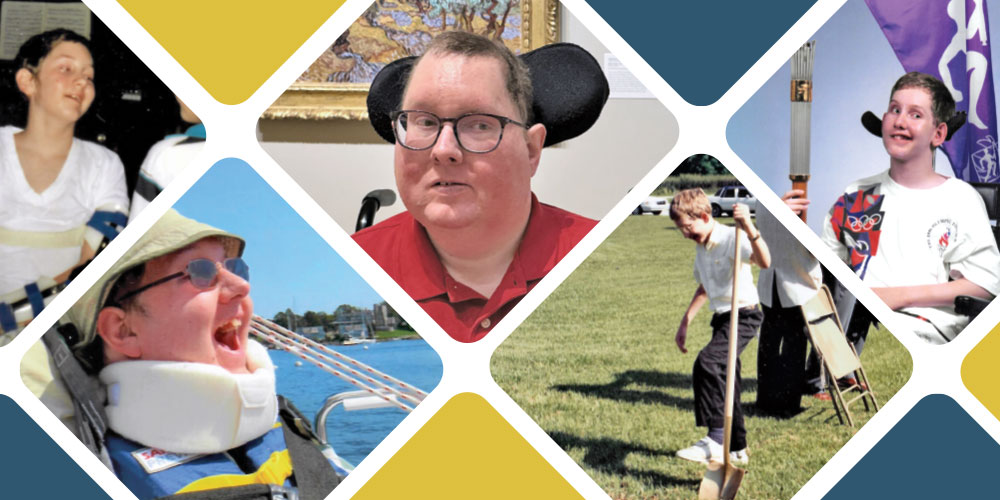
In the years following the stroke, Mark was able to earn an IEP degree. In a wheelchair, he was a torchbearer for the 1996 Olympic Games, as the flame traveled to its Atlanta destination. Mark has gone through 69 surgical procedures, the majority of which were neuro-related.
Through it all, Mark’s faith shines brightly, even though it is becoming more difficult for him to express himself. Judy notes, “Mark goes with the flow extremely well. He doesn’t complain. He accepts what’s there.” Mark’s faith shines brightly in another way, as he often beats Pat and Judy in Bible trivia. “But,” his parents add, “he uses the kids’ cards.”
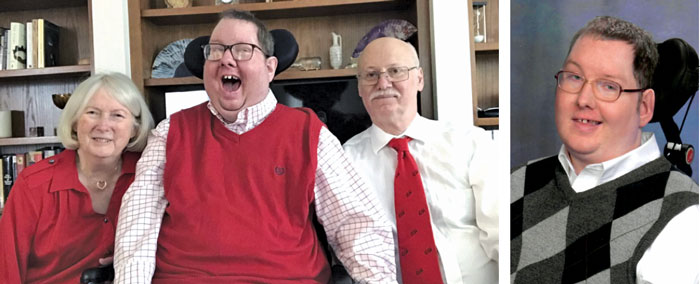
After caring for Mark for more than three decades in Florida and later New York, Pat and Judy could not provide Mark—now age 42—the level of care he needed. So after learning about the facilities at The Lutheran Home in Belle Plaine, Minn., the three relocated to the Land of 10,000 Lakes. Mark’s residence offers skilled nursing, while Pat and Judy live in an independent community on the same campus.
The family attends Trinity in Belle Plaine. Judy, a classical pianist, is a regular piano and organ accompanist for worship services and the women’s choir. Pat is involved in congregational committees. Their ongoing care of Mark continues to impact others. Martin Bentz, one of Trinity’s pastors, notes, “The Frasers have displayed the patience of Job at times in the care they have given their son Mark. They have been wonderful examples of Christian faith and perseverance here at Trinity.”
What is next for the Frasers? Judy has begun writing a book about the family’s experiences. She explains that it is a painful process reliving past events, but she wants to tell Mark’s story . . . his story of being a special child of God.
Author: James Pope
Volume 113, Number 03
Issue: March 2026