|
WELS’ 2024 statistical summary weaves a narrative of challenge, resilience, and Christ’s abounding faithfulness.
Numbers tell stories. WELS’ 2024 statistical summary weaves a narrative of challenge, resilience, and Christ’s abounding faithfulness. Behind every statistic—births and deaths, gains and losses—are souls for whom Christ died. As we reflect on this year’s data, we see a church navigating a shifting cultural landscape yet firmly anchored in the love of Christ.
That’s why these statistics matter. They are not cold data points. They are windows into our ministry—snapshots of the Spirit’s work in real time. Each adult confirmed is a soul brought from death to life. Each child baptized is a sinner now washed clean. Each person who drifts away is someone we grieve—not a name on a spreadsheet but a brother or sister for whom Christ died. These numbers call us both to repentance and rejoicing: repentance where we have grown complacent; rejoicing where God has been faithful despite our weakness. Statistics won’t save anyone. But they can stir us to pray, to proclaim, and to labor with hearts full of Christ’s love.
A remarkable year of grace
In recent years, we have noted some positive statistical trends in WELS. These continued in 2024. Consider these blessings: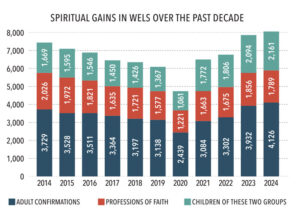
- Spiritual gains surge. In 2024, WELS recorded 4,100 adult confirmations—the second-highest total ever. Many adults brought children with them. WELS gained almost 2,200 baptized members as a result of their parents joining our congregations.
- Worship and Bible study rebound. In-person worship attendance rose almost 3 percent, marking the fourth consecutive year of growth. Adult and youth Bible study attendance climbed 2 percent and 1 percent respectively. This is no longer post-COVID rebound. It is the saints, moved by the Spirit, planting the roots of their faith deeper in the water of the Word.
- Shepherding efforts soar. Face-to-face visits with straying members have risen over 60 percent in the past four years. The Spirit has blessed these efforts, demonstrated by a large decline in spiritual losses—down to 2,300, compared to the previous decade’s average of closer to 5,300 annually.
- Generosity abounds. Total offerings exceeded $400 million. Congregation Mission Offerings rose 2.4 percent, sustaining WELS’ mission work despite inflation.
But not without challenges
The statistics for 2024 also illustrate challenges.
- WELS membership declined again—down 2,675 souls to 327,943. However, that 0.8 percent drop is the smallest in a decade.
- Total births remain low at 2,985. We note that WELS’ gross birth rate, while substantially lower than previous decades, has remained steady for the past five years. We pray that trend continues. However, that may be challenging given the fact that in 2024, for the first time since WELS has been recording statistics, there were fewer than 1,000 weddings performed in WELS churches. Two-thirds of WELS congregations had none at all.
- While backdoor losses have declined, WELS will continue to feel the effects of recent decades. For example, last year’s youth confirmations declined to 3,442, the lowest ever, reflecting the 20-year decline in our total birth rate. That decline is also creating a steep enrollment cliff in our schools.
- On the congregational level, we note that two-thirds of churches lost members over the past decade, with 41 percent declining in membership by 20 percent or more. Currently, about two in five congregations have an average weekly worship attendance under 50. One in seven worship fewer than 25. In many places, dwindling membership has made it hard to sustain vital ministries. These trends simply mirror broader challenges in American Christianity.
Correcting false narratives
If we want to attempt to meet the challenges with the strength God provides, we need to understand those challenges with the wisdom God also provides. Therefore, the 2024 statistical summary also focused on some common narratives within WELS. Are they true?
“Young WELS couples don’t have children anymore.” Actually, when we compare annual marriages to births, the data demonstrates WELS couples have about the same number of children today as a decade ago. WELS simply has substantially fewer young adult members. The real challenge isn’t a crashing fertility rate but young-member retention. Backdoor losses, particularly among 25- to 34-year-olds, are the largest strategic issue in WELS.
“Young people don’t want to study for ministry anymore.” Actually, when you look at enrollment in our ministerial education schools as a percent of that age demographic, young WELS people are studying for ministry at near historic high rates. We simply have fewer college-aged WELS members than in previous decades. Again, the real challenge is retaining our young adults.
“WELS has so few called workers.” Actually, WELS has more called workers today than at any point in our history by a wide margin. The percentage of working-age communicant members who serve in ministry is also the highest ever. The true challenge is that gospel opportunities—new mission fields, growing schools—have grown faster than our supply of workers.
A church in transition; a realistic optimism
The year 2024 makes this crystal clear: WELS is changing. For a century, in a typical year, WELS had more births than deaths. In the past five years, that has flipped. Yet, this has been partly offset by record-high spiritual gains and record-low spiritual losses. While not many congregations gain new members through school outreach ministry, the ones that do tend to be growing younger. While only 22 percent of all adult confirmations in 2024 came from school outreach, those congregations accounted for about one-third of youth spiritual gains. In a church body facing birth rate decline, that is no small blessing.
The bottom line: The 2024 data demonstrates some stabilization in our church body. In fact, if the underlying trends of recent years were to continue, by God’s grace, within the next decade WELS total membership might trend in a positive direction. However, we need to be realistic about what that would take. Paul says, “We are therefore Christ’s ambassadors, as though God were making his appeal through us” (2 Corinthians 5:20). The growth of the church—both spiritual and statistical—is Christ’s work. But Christ says he does that work “through us,” sending us as his ambassadors into the world.
That growth would not happen overnight nor uniformly. It would come through everyday faithfulness: members inviting neighbors, elders making phone calls, teachers modeling Christ’s love to unchurched families. It would require congregations to rethink old assumptions and perhaps embrace new approaches, while holding fast to unchanging truth. But if the trend continues—more outreach, fewer backdoor losses, and steady evangelism—then the numerical decline that has defined a generation of WELS ministry might finally level out. And more important, many more will hear the gospel and find life in Christ.
So, let us gladly take up the work Christ has given to each of us. Let us labor not for numbers, but for souls. Not to preserve what was, but to proclaim what is ours in Christ. Not to avoid decline, but to announce resurrection.
Read the entire statistical summary at welscongregationalservices.net/wels-statistical-report-2024.
Author: Jonathan Hein
Volume 112, Number 08
Issue: August 2025