 |
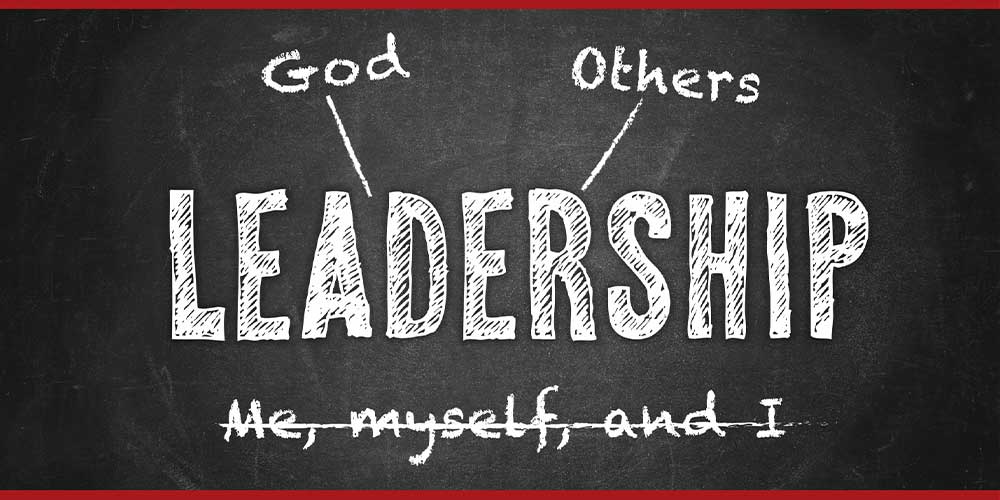
As Christian leaders in a “me-first” world, we need to put aside our self-interest and focus on God and others.
“My three favorite people are . . . me, myself, and I.”
Those words are meant as a joke, but maybe you’ve met individuals who seem to think that. They insist on telling others everything they’ve accomplished and how important they are. Call them first-person people, whose self-absorption is a bit annoying.
Sadly, I don’t have to go far to see someone who acts like his three favorite people are “me, myself, and I.” He shows up each day in the mirror. That self-centeredness, evidence of the sinful nature still clinging to us, stands in opposition to God’s design for our lives.
The new self the Lord formed within us, however, rejects that first-person emphasis. As God calls us to lead in different aspects of our lives, he invites us to third-person leadership, whereby we focus on the Lord and others rather than “me, myself, and I.”
The Scriptures are filled with examples of this kind of leadership.
John the Baptist: Making ourselves less
Put John the Baptizer on the list of third-person leaders. Though he was an important man fulfilling a critical God-given role, he did not consider himself the central character of the story. He embraced his assignment of preparing the way for the Messiah.
As John carried out his unique calling in the wilderness, preaching a baptism of repentance for the forgiveness of sins, he became a must-see attraction. Everyone from Jerusalem and Judea had to see for themselves this unique character, dressed in camel’s hair clothing and feasting on locusts and honey. His preaching was so powerful that many began to wonder if he might be the Lord’s Anointed.
John had the opportunity to cash in on his popularity. At a bare minimum, he deserved a wardrobe upgrade. A little more variety in his meal menu seemed reasonable too. And it was only right that he should receive some adulation for his hard work.
John, however, steadfastly refused to seize that opportunity. Desiring that all attention be focused on Jesus, John put a hard stop to the question of who he was. He stated unequivocally, “I am not the Messiah” (John 1:20). More than that, he freely confessed that the Christ was in a class by himself. John wasn’t even worthy to untie the straps of the Messiah’s sandals. John was all about Christ, not himself.
When Jesus began his public ministry, he and his disciples were baptizing in the Judean countryside. The crowds that had once flocked to John now rushed to Jesus. That development concerned some of John’s disciples. They reported the issue to John, assuming he would develop a plan to preserve his honor. Instead, John rejoiced in the news and encouraged his disciples to do the same. After all, this was exactly what God designed and what John himself desired: “He must become greater; I must become less” (John 3:30). A godly leader, John eagerly faded into the background so that all attention would be on Christ.
Being a third-person Christian leader means embracing John’s approach: “He must become greater; I must become less.” Christian leadership aims at the glory of God in Christ rather than honor for self. Unfortunately, the old self is an inveterate glory-seeker, desperate for praise from others. The sinful nature, however, does not control us. The new self knows this: God delights in us through his Son. We do not live by the approval of others but by God’s approval in Christ. That allows us to put aside self-interest and be third-person leaders, with our lives all about Christ.
The apostle Paul: Becoming a slave to everyone
Like John the Baptizer, the apostle Paul was a third-person leader. Astounded that the Lord would call him into public ministry, Paul poured himself into that work for the benefit of others. Though he faced persecution at nearly every turn, he labored on. He wanted everyone to hear and believe that Christ Jesus had come into the world to rescue sinners and give them eternal life.
The apostle embraced the idea that ministry was all about serving others. In 1 Corinthians chapter 9, Paul outlined his approach: “Though I am free and belong to no one, I have made myself a slave to everyone, to win as many as possible” (v. 19).
Paul could have demanded his “rights” as an apostle. He could have insisted that people respect and serve him because the Lord himself had appointed him as a leader in the church. Instead, Paul set aside his rights and freely chose to be a slave to everyone. He sought the best interest of others, not his own. He wanted to save them from everlasting suffering. That meant preaching the powerful message by which the Spirit creates faith and gives eternal life, even if it meant being imprisoned, flogged, or beaten with rods. He deemed suffering for the preaching of the gospel a small price to pay for the sake of bringing others to the Savior.
Being a third-person leader means following in Paul’s footsteps. It means setting aside personal rights and interests, considering others more important than ourselves, and striving to do what is best for them. Paul writes, “Each of us should please our neighbors for their good, to build them up” (Romans 15:2).
Lydia: Using blessings for ministry work
Count Lydia among the third-person leaders in Scripture. A dealer in purple cloth, Lydia was a prominent person doing important work. Her clientele probably included people of means who occupied significant positions in society. While we have no record of her net worth, she was likely a wealthy woman. When the Lord graciously brought her to faith, he convinced her that she had been blessed by God to be a blessing to others. In particular, she considered her wealth and her home as gifts to be used to support the spread of the gospel through which the Lord had given her life.
After she and her household were baptized, Lydia pleaded with Paul for the privilege of using what the Lord had given her for others. Luke relates that Lydia invited them to stay at her house, that is, to use her house as their base of operations while they shared the good news about Jesus with people in the area. Lydia didn’t just extend an invitation, either. “She persuaded us” (Acts 16:15), Luke says. Her eagerness to put the Lord’s blessings to use in the spread of the gospel influenced them to stay at her home. At the end of Acts chapter 16 there’s indication that the Christians in Philippi met regularly in her home to hear God’s Word.
We live in a decidedly first-person world, with a focus on self. But the Lord calls us to something higher—third-person leadership.
Third-person leadership means approaching life with Lydia’s attitude. It means taking stock of the many blessings the Lord has bestowed on us and consistently using those blessings for the benefit of others and the spread of the gospel. The apostle Peter put it this way, “Each of you should use whatever gift you have received to serve others” (1 Peter 4:10).
We live in a decidedly first-person world, with a focus on self. But the Lord calls us to something higher—third-person leadership. It’s all about him (the Lord). It’s all about them (the people around us). And that leads us to use the gifts God has given us for the benefit of others and the spread of the gospel.
Author: Earle Treptow
Volume 113, Number 1
Issue: January 2026