 |
The Lord was in complete control of the events on Palm Sunday and all his redemptive work. He remains in control of all things.
Imagine that your favorite team wins the championship. When the team gets home, your city throws a parade to celebrate the victory. This parade is often planned ahead of time, including securing sponsors and vendors, expediting permits for street closures, coordinating with law enforcement, and considering weather forecasts—everything but the specific date, route, and time because the victory had not been secured yet. What if your favorite team threw a victory parade before playing the championship game? Imagine how ESPN would react!
That is exactly what Jesus did on Palm Sunday. He had not won a championship. So why did the people treat him like a triumphant king? Many of them had hoped that he was the Messiah King who would come to save, although they misunderstood his kingdom to be an earthly one. Whether the people fully recognized it or not, this was a planned victory procession five hundred years in the making, and everything was in Jesus’ control.
The gospel writers Matthew and John loosely quote from Zechariah 9:9: “Rejoice greatly, Daughter Zion! Shout, Daughter Jerusalem! See, your king comes to you, righteous and victorious, lowly and riding on a donkey, on a colt, the foal of a donkey.”
A planned ride
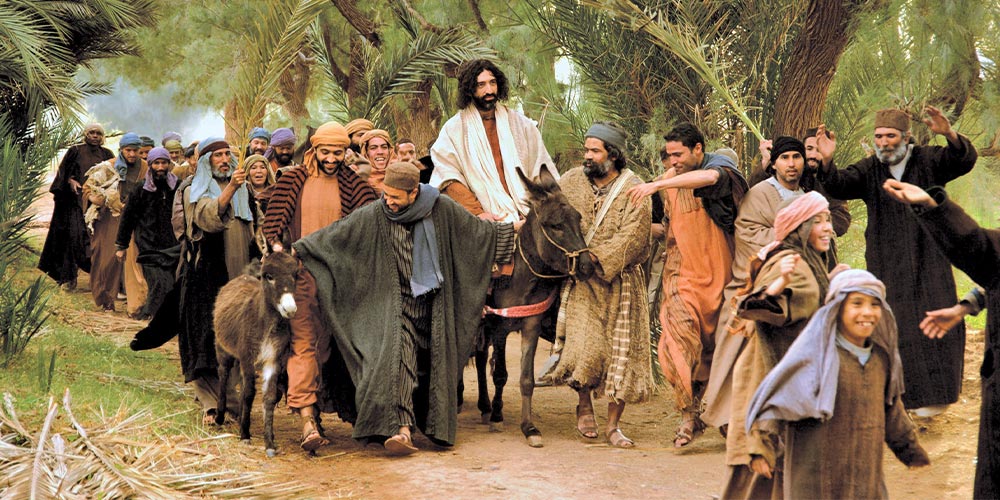
As Jesus and the disciples approached Jerusalem on the day known as Palm Sunday, he instructed them, “Go to the village ahead of you, and at once you will find a donkey tied there, with her colt by her. Untie them and bring them to me. If anyone says anything to you, say that the Lord needs them, and he will send them right away” (Matthew 21:2-3).
The disciples “went and found it just as he had told them” (Luke 19:32). They found the donkey and its colt tied up just where Jesus said they were going to be. The owners reacted and consented just as Jesus said they would. Everything was going as planned because Jesus was in control.
Why not walk into Jerusalem like they had done every other time? Why would Jesus need not only a donkey but also its colt? Jesus needed to fulfill Zechariah’s prophecy, which includes both the donkey and colt, even though he rode on only one. Jesus was fulfilling prophecy.
Jesus clearly intended to send a message with this mode of transportation. This was no sturdy steed to display power. While a lot of kings in the Old Testament rode on donkeys, in Jesus’ day they were known more as beasts of burden, animals to be ridden in peace time or even used as instruments of degradation. So this ride preached the kind of king he came to be. Jesus did not throw a parade displaying all his power like Caesar Augustus did after defeating Mark Antony. Jesus came “lowly and riding on a donkey.” The salvation he brought required humility—a humble death on a cross to achieve this victory and bring about peace. The best animal to express that was a lowly donkey.
Planned rejoicing
Jesus was received as the messianic King, even if the crowd and his disciples did not fully understand it all (John 12:16). The people gave Jesus kingly treatment—rolling out the red carpet by laying down their cloaks or branches in front of him (see 2 Kings 9:13). Everything was going according to plan.
The people rejoiced and shouted with words put in their mouths by God: “ ‘Hosanna to the Son of David!’ ‘Blessed is he who comes in the name of the Lord!’ ‘Hosanna in the highest heaven!’ ” (Matthew 21:9). The Hebrew hoshiana is often translated as “Save now!” More than a prayer for help, this was a joyful prayer of certain victory. These words from Psalm 118 were often used during the Passover Festival: “LORD, save us! LORD, grant us success! Blessed is he who comes in the name of the LORD” (Psalm 118:25-26). The Jews ate their paschal lamb every Passover with these words on their lips. Now the true Paschal Lamb had come to fulfill these words. He came to save and give people his victory.
Jesus rode into Jerusalem like he had already won.
Jesus understood this victory parade and enthusiasm of the crowd would enrage the hostile religious leaders in Jerusalem and advance their plan against him. Jesus would willingly place himself in their hands to move his plan forward. Jesus saw the cross that he would face at the end of the week. He knew he would lay down his own life for all people. He knew he would triumph over sin, death, and the devil. So Jesus rode into Jerusalem like he had already won. To God, who is outside time, this victory was as good as done.
Jesus is in complete control
The Lord was in complete control of the events of Palm Sunday and of everything in his redemptive work. Multiple times throughout the first part of his gospel, John recorded that Jesus’ “hour” had not yet come. Suddenly, after Jesus entered Jerusalem, he declared to the people, “The hour has come for the Son of Man to be glorified” (John 12:23). Jesus was in complete control of his time.
He is also in complete control of ours. Scripture is clear: “I trust in you, LORD; I say, ‘You are my God.’ My times are in your hands” (Psalm 31:14-15). “The LORD will keep you from all harm—he will watch over your life; the LORD will watch over your coming and going both now and forevermore” (Psalm 121:7-8). “We know that in all things God works for the good of those who love him, who have been called according to his purpose” (Romans 8:28). When things seem out of control in the world or in our lives, God comforts us with promises like these.
Our King—who rode into Jerusalem, gave his life at the cross, and left the grave empty—has now ascended into heaven to rule all things for the good of his church (Ephesians 1:20-23). Jesus is in complete control.
A planned final victory
This wasn’t just a plan five hundred years in the making. It was a plan conceived before the creation of the world and a plan that will extend into eternity. Over the years, God revealed more about his plan that he gave through prophets like Zechariah (see Ephesians 1:4-11; 1 Peter 1:20; 1 Corinthians 2:7).
When Jesus comes again, he will not come gently and riding on a donkey; instead, he is pictured riding a warhorse to destroy our enemies once and for all (Revelation 19:11). On that day, he will purge the world of sin, death, and the devil forever. Then we will follow him, holding palm branches, as he rides into Jerusalem the golden, where we will enjoy eternal peace. What the Lord God has planned from the beginning, he will bring to completion. From beginning to end, our redemption is in the hands of our God. And with God’s plans, there is never a doubt.
His plans are as good as done.
Take heart! Jesus is in complete control.
Author: Nathanael Brenner
Volume 113, Number 04
Issue: April 2026