 |
How congregations and their members can faithfully use digital tools to reach people with the gospel.
During my last visit to the doctor, I prefaced a conversation about a minor new symptom by admitting, “I already Googled some information about it.”
I wasn’t claiming to be a medical expert, but I had a concern and began by searching online for answers.
Maybe you’ve done the same.
Consider what the people in your community are looking for online. A mom scrolls parenting blogs after the kids are finally asleep. A young adult watches a video that answers a question he has been afraid to ask. A grieving widower searches for support, connection, and hope. A couple quietly looks for help because the marriage feels strained.
Many of them are not searching for “the nearest Lutheran church,” but they are searching for hope, meaning, truth, parenting help, answers, belonging, and peace.
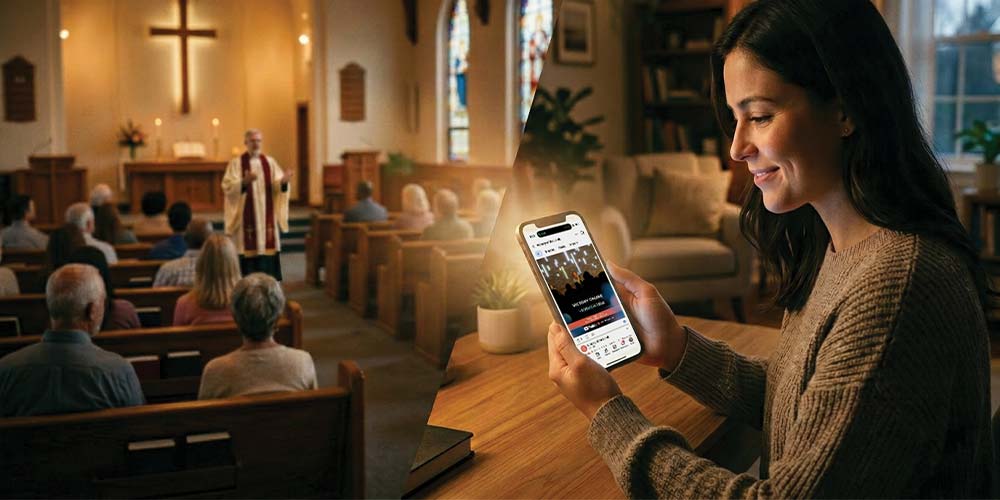
A Pew Research Center report this year noted that four in ten US adults say they are almost constantly online.¹ In our increasingly post-Christian culture, many people do not have a church background or a habit of turning to Scripture when life gets hard. Before they ever walk into a worship service, they are more likely to encounter a congregation first through a Google search, a social media post, a live stream, or a text message from someone they trust.
So how can congregations and their members faithfully use digital tools to reach people with the gospel?
We can start by framing digital methods as an opportunity to build bridges. A few posts on a church’s Facebook page will not be a silver bullet that doubles attendance before Christmas. But a thoughtful approach to meeting people where they already are can become a pathway toward real conversation and personal witness.
Know whom you are trying to reach
A local heating and cooling company in our area runs TV commercials that are a little cheesy and clearly low-budget. Every time one of them comes on, my two-year-old son stops and watches the entire thing.
Did they capture his attention? Absolutely.
Is he the ideal customer for home repairs? Not yet.
Attention is not the same thing as effectiveness. In outreach, it matters whom we are trying to reach. Congregations should ask two practical questions.
First, who is in our community? Are the people around our church mostly young families, retirees, or single adults? What challenges are they facing, and what worries keep them up at night?
Second, whom is our ministry best positioned to serve? A congregation with a strong school, childcare connections, and family ministry may be especially equipped to reach young parents. A church with many retirees may be well-positioned to connect with older adults experiencing loneliness or grief. A congregation with strong Bible information classes may be ready to welcome spiritually curious adults who have many questions but little church background.
Clear outreach begins with knowing the real people God has placed around us. But this is not just about data; it is about making meaningful connections that reflect your mission and open doors for the gospel.
Try it this week: Go somewhere in your community that is outside your normal routine. Visit a different grocery store, coffee shop, park, or restaurant. Observe who is there. What do you notice? Whom do you see that you might not have seen before?
Create content worth sharing
Digital media has upended many traditional forms of communication. I imagine the apostle Paul would have appreciated the speed of e-mail to send his letters to Corinth and Philippi. WhatsApp may have been an easier way to communicate with Timothy.
The tools change. The message does not.
So how is your church using digital platforms?
Social media should not simply be a digital replacement for the church bulletin board. There are real opportunities online to reach beyond your members and into your community with the love of Jesus.
Consistency matters more than trends. A church should choose platforms intentionally based on whom it’s trying to reach and then develop a sustainable rhythm. Consistent, useful content builds trust over time.
Make content and design choices that align with the group you are trying to reach. That might include
- short Scripture encouragement,
- answers to common questions about Christianity,
- short sermon clips with one clear gospel thought,
- testimonies from members,
- “what to expect at church” content, and
- practical tips for marriage, parenting, grief, anxiety, and more.
The best church content is not merely content about the church. It is content that leads people to Jesus.
Try it this week: Look at your church’s social media pages. Is the content current? Is it understandable to someone with no church background? Does it answer real questions people are asking?
Try adding one new type of content from the list above.
Engage with words, not just links
Knowing whom you are trying to reach and creating content worth sharing are foundational steps. But a church posting on social media does not fully check the box of evangelism.
Personal invitation still matters.
In fact, digital content becomes most powerful when members use it as a bridge to real relationships. Many Christians want to invite others but do not know how to start. A church post, sermon clip, event invitation, or short devotion can give them a natural starting point.
Equipping members to share and invite using your church’s social media content is a double win. First, a personal invitation is often the strongest reason someone may say yes. Second, it helps the church’s content reach new audiences. Each like, comment, and share signals the platform to show the content to even more people.
Digital content becomes most powerful when members use it as a bridge to real relationships.
But invitation takes more than a link.
Instead of simply reposting something from church, a church member might add:
- “This encouraged me today.”
- “Want to come with me this Sunday? We can sit together.”
- “Could I pray for you about that?”
That small, personal sentence can make a big difference. It turns passive sharing into personal witness.
Try it this week: Like, comment on, or share one post from your church. Then add one personal sentence: “This encouraged me because . . .” or “Want to come with me Sunday?”
Connect real people with Jesus
Digital outreach can be difficult to measure. Views, clicks, likes, shares, and comments can tell part of the story, but they don’t tell the whole story. The goal is not simply to get more attention online. It is to connect real people with the real hope of Jesus. When that happens, it is something to celebrate.
Digital outreach will not replace Christians loving their neighbors in ordinary, personal ways. It was never meant to.
But in a world where many people begin their search for hope online, digital outreach can become one more bridge. One more invitation. One more conversation. One more opportunity to share the love of Jesus in a way that makes a difference.
¹pewresearch.org/short-reads/2026/01/08/internet-use-smartphone-ownership-digital-divides-in-u-s
Author: Michael Babler
Volume 113, Number 07
Issue: July 2026
Image: Created using Adobe Firefly