 |
Discussing politics is a risky business in many settings today. Yet we can’t let that scare us into not discussing politics at home, because our children need a road map for how to have these conversations in a way that lets their lights shine as Christians. Although it may feel safer and easier, I don’t think that civic engagement should be eschewed. God encouraged his people to live out their faith while serving as citizens of earthly kingdoms. What does that look like for today’s Christians, and how can parents help their children develop as Christian citizens?
—Nicole Balza
“I voted!”
Maybe you’ve worn that sticker after leaving the polls or even posted on social media to celebrate rocking the vote. Early on, my parents—especially my dad—taught me the value of civics. They got me excited about elections, debates, and geography. We talked about it at the dinner table or while watching coverage on TV. They taught me to recognize the blessings of the freedom we have in the United States, modeling how incredible it is to be a citizen of this country and world.
From the moment I turned 18, I’ve been excited to participate in this duty and privilege. So many people shed blood and gave their lives so that I could show up to the polls and freely vote my conscience.
This is exactly how my husband and I approach it with our three daughters. Our youngest is turning 18, and she is looking forward to the fact that her turn is coming. She asks questions, and we keep an open dialogue. We celebrate civic duty and encourage our girls to be informed, to vote, and to pray for our nation and world, just as God commands us in 1 Timothy: “I urge, then, first of all, that petitions, prayers, intercession and thanksgiving be made for all people—for kings and all those in authority, that we may live peaceful and quiet lives in all godliness and holiness” (2:1-2). We may not always agree on every political point, but we agree to be respectful and trust God, knowing he rules over all things and that all authority comes from him (Romans 13:1-7).
Our oldest daughter takes this privilege entirely to heart. Early in the morning of our last Wisconsin primary, she came barreling into the house before work, excited to take part in another voting opportunity.
She hollered, “C’mon, Mom, are you going to vote?”
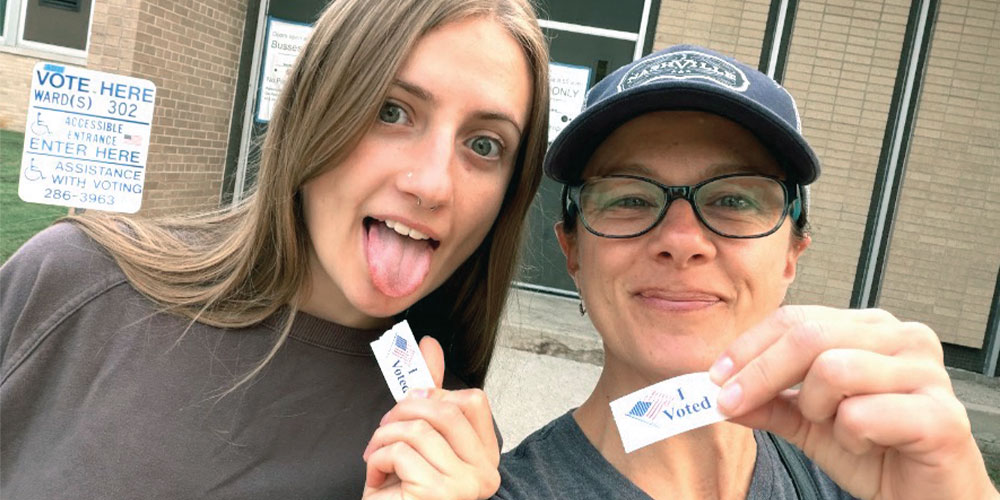
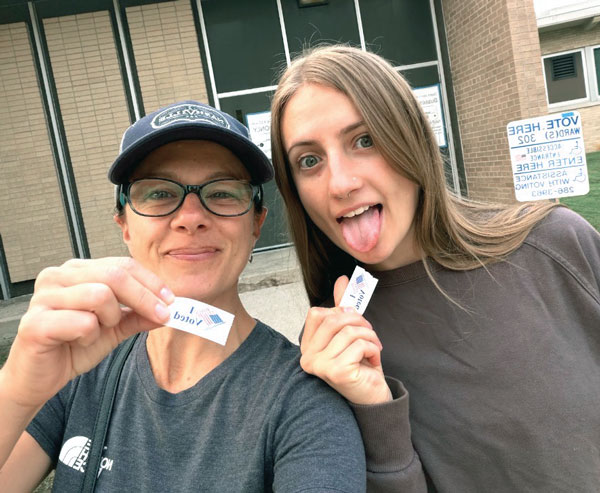
I had planned on going, just not quite that early! But I threw on a baseball cap and some sweats, embracing the chance to share that moment with her. We are fortunate to live within walking distance of our polling site, and that morning, we were the first two voters on the record for our district. It made me incredibly proud. We put our stickers on, snapped a selfie, and walked home together in the drizzle.
Civic duties stretch far beyond voting, and they happen on many scales. We can teach our children about the responsibilities we hold as citizens of our communities, states, nations, and planet. We can lead them to see the blessings that flow from community involvement—like keeping neighborhoods clean, paying taxes, reporting for jury duty, entering military service, respecting those in authority, pursuing education, and treating fellow citizens with honor and respect.
This is the exact message God gave to his people exiled in Babylon: “Seek the peace and prosperity of the city to which I have carried you into exile. Pray to the LORD for it, because if it prospers, you too will prosper” (Jeremiah 29:7). God uses all of these systems to bless us. God’s people were far from home and in unfamiliar territory in Babylon, yet he called them to serve in those communities and to respect their leaders, and he promised he would bless them and ultimately deliver them back home again.
Think about Joseph. Though he was carried off as a slave, falsely accused, and imprisoned, God enabled him to respect the government of a foreign land. God eventually raised him to a place of authority, allowing him to save millions of lives and preserve the line of the Savior. Throughout Scripture, we see this pattern: God working through earthly rulers and governments to strengthen trust in him, accomplish his will, and carry on the line of Jesus.
Like the Israelites enslaved in Egypt or exiled in Babylon, we live in two kingdoms. We are exiles here, knowing our true citizenship is in heaven. Yet while we live in this earthly kingdom, God calls us to be citizens who respect his representatives, seek peace, support prosperity, and pray for our leaders.
Let your children see these responsibilities as gifts. Teach them to pray for our world and its leaders. Encourage them to exercise their civic duties. Wear the sticker, take the selfie, and share the joy and peace of knowing that God’s good and gracious will is always done.
Amanda Berg
Once a month, I sit around a podcast table with two pastors to record an episode on current events for The Life Challenges Podcast from Christian Life Resources. For each episode, we choose a handful of events related to life and family issues. Our reason for discussing them on the podcast is twofold: first, to inform listeners of important news they might have missed, and second, and most important, to offer a Christian perspective on those topics.
But arguably the more important conversations are the ones that happen the day before around my kitchen table.
When I started cohosting the podcast five years ago, my four children mostly had their baby teeth, and it didn’t seem like the time to be sharing the controversial topics we discussed. However, a few months ago, I started talking more with my children, especially my older two, ages 10 and 12, about the topics we cover on the podcast.
It surprises me how they react to certain topics. There is usually the initial response of shock or a “How can that be true?” but as we dig more into the subject, there usually is more understanding and a deepened sense of compassion.
These conversations aren’t about telling my kids what to think about every issue in the headlines, but they are about teaching them to notice what’s happening in the world. My kids understand that not everyone sees the world like they do, and they learn to filter what they hear through Scripture rather than through whatever voice is loudest.
As we go through events together, they are challenged with what it means to be a Christian citizen: You don’t always agree with what is going on, but you can have a Christian posture by staying informed, staying engaged, and bringing every issue back to God’s Word.
I don’t know yet what kind of citizens my kids will grow up to be. But I hope they continue to stay well-informed and consistently view the world through a biblical lens, whatever the current events of their own day turn out to be.
Christa Potratz
Author: Multiple authors
Issue: November 2026
The Life Challenges Podcast
Interested in hearing about current events from a Christian perspective to help you as you discuss them with your children? Christian Life Resources’ The Life Challenges Podcast aims to discuss modern-day issues from a biblical perspective. One recent episode, titled “Postpartum Psychosis, Justice, and the Value of Children,” focused on the Clancy case. Another discussed how the Ten Commandments guide life and family topics.
Learn more at lifechallenges.us.